





  • Wealth Management
  • Asset Management
  • Wealth Management
  • Asset Management
Location
  • United Kingdom
    Language
  • Jersey
    Language
  • Guernsey
    Language
  • US
    Language
  • MyRathbones login
  • Financial Planning login
  • Donor Advised Fund login
Home
  • Who we help
    Who we help

    We help a wide range of clients invest well so that they can focus on what matters.

    Who we help
    • Individuals and families

      Focusing on you and your individual goals.

    • Financial advisers

      Working with you, for your clients.

    • Professional partners

      We work with lawyers, accountants and other professionals.

  • Our services
    Services

    See our wide range of services tailored for your needs.

    Our services
    • Investment Management

      Looking for someone to create an investment portfolio for you?

  • About us
    About us

    A leading UK wealth manager with roots dating back to 1742.

    About us
    • Careers

      Learn more about what it’s like to work at Rathbones, and search our current vacancies.

    • Corporate governance

      Learn more about our Board, Executive Committee and our approach to corporate governance.

    • Media centre

      Read the latest news from Rathbones Group.

    • MyRathbones – Our digital platform

      Our secure online portal and app, designed to give clients a clear view of their investments with us.

    • Our purpose

      Our driving purpose is to help more people invest well, so they can live well.

    • Responsible business

      We believe in doing the right thing for our clients and for others too.

  • Insights
    Insights

    Read the latest news and market commentary from our specialists.

    Insights
    • Investing

      Read about the key investment themes affecting global markets.

    • Responsible investing

      Explore our articles, reports and events on investing responsibly.

    • Webinars

      Timely insights, real conversations. Watch live or catch up anytime.

  • Contacts
    Contacts

    Whether you have a question about our services, or need to talk someone specific, we can help.

    Contacts
    • Our offices

      Find your local Rathbones office. We have 21 across the UK and Channel Islands.

    • Our people

      Find the contact details for your Rathbones team by searching our people’s directory.

    • Let's talk

      Our team will be in touch to help you book a no obligation consultation with an adviser.

    • Our media contacts

      Access the contact details for our media team.

    • Other contacts

      Need to contact us about something else? Here you'll find all the options.

Let's talk

SearchStax standalone input

Investment Insights Q4 2023: Higher for longer

25 October 2023

The world has changed profoundly since the late 2010s, and the opportunities available to us as investors along with it. The strategies that serve us well today will look different to those that worked best in the unusual low-rate, low-volatility environment of the last decade.

  1. Home
  2. Guernsey
  3. Knowledge and Insight
  4. Investment Insights Q4 2023: Higher for longer

Article last updated 25 November 2025.

Higher for longer has implications for investors


The deluge

Just over a century ago, the world was also reeling from war in Europe and a pandemic, along with double-digit inflation. Contemporaries compared those events to a flood of Biblical proportions. Both Winston Churchill and wartime Prime Minister David Lloyd George called the period “the deluge”, an image also used by artists and poets of the time. By the early 1920s, the deluge was receding. Inflation had dropped sharply from double-digit rates as the acute turmoil subsided. The floodwaters also appear to be retreating today, with some of the damage done by the pandemic and war starting to heal.

For example, the once-in-a-generation chaos in global supply chains which followed the coronavirus pandemic has now largely abated. Last year’s lengthy delays at shipping hubs have disappeared, bottlenecks of critical components have dissipated, and firms have had time to rebuild their inventories. The outcome has been falling goods inflation, with further declines likely. Manufacturers around the world report that growth in their selling prices has slowed sharply.

Although the war in Ukraine continues, a similar pattern is evident when it comes to its global impact. The prices of key commodities, like natural gas and wheat, jolted higher after the invasion. But they’ve since dropped to even lower levels than just before Russia attacked (figure 1). The world has adapted to the conflict in remarkable ways, reconfiguring trade routes or learning to live without Russian supply.
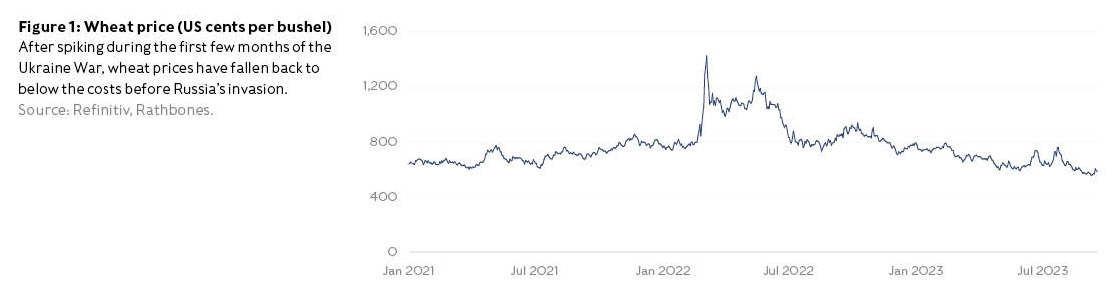
Line graph showing the price of wheat has fallen back to below the costs before Russia's invasion of Ukraine

This too is already feeding through to lower inflation, helping to bring it from more than 11% last year to under 7% in the UK now. Again, there’s probably a lot more disinflation to come as the fading of this shock continues to filter through to consumer prices. UK food producers now report that the prior surge in their input prices is over.

We’re starting to see the first signs of that on supermarket shelves, and inflation there is likely to slow much further later this year. In the meantime, the statutory price cap on energy bills, which rocketed in 2022, is now declining. This alone should help to pull inflation down markedly later this year. Price pressures in the UK have not been tamed yet, but the outlook has improved considerably.


After the flood

Even as Churchill spoke about the deluge of his day subsiding, he argued that “violent and tremendous changes” had been left in its wake. Lloyd George, too, talked about “unheard-of changes”. The illusory stability of the Edwardian era gave way to a new regime of volatility in the interwar years.

Once again, there are parallels to the present day. Inflation may be abating — in the US it is already back in the low single digits — but other changes induced by pandemic and war will be with us for much longer. Both the challenges policymakers face and the tools they’re willing to deploy appear to have changed since the 2010s, suggesting that the economic backdrop in the coming decade will also look quite different.

Geopolitical rivalries have intensified, while awareness of the dangers that human interaction with the natural world can cause has increased. Governments are placing more emphasis on building resilience in supply chains, rather than maintaining efficiency (and minimising cost) as previously. And they’re increasingly willing to use long-neglected industrial policy to support this goal. Both the US and EU have passed major acts supporting domestic chip production and the green transition.

Through their experience in the pandemic, Western governments have also rediscovered their lost appetite for activist fiscal policy, in contrast to the budgetary consolidation of the 2010s. Consumers’ balance sheets have been strengthened by the huge fiscal interventions of the pandemic too. That’s another contrast to the years immediately after the global financial crisis, when households were trying to repair their damaged finances. In the round, the economic conditions which underpinned the demand-deficient regime of the last decade — when the monetary policy tools of central banks were compelled to do much of the heavy lifting — have fundamentally altered.


The new old normal

The full implications of these changes will take years to become clear. But we are confident about a couple of points. First, interest rates will stay higher on average than their rock-bottom rates in the 2010s, even as the recent burst of inflation continues to fade. The conditions that kept monetary policy ultra-loose for a decade have changed. Rates should fall from current levels at some stage, but not get mired near zero again. Second, volatility — in inflation, interest rates and economic performance generally — will be greater than it was during that decade. That reflects a combination of things, including the new policy environment plus the risk of greater geopolitical and climate-related shocks.

In some ways, these changes shouldn’t be at all surprising. The 2010s were unusual with the lowest interest rates in centuries of recorded history (from the 1600s in the UK), and the second-lowest volatility in inflation (going back to the 1200s). The ‘new normal’ after the pandemic and war in Ukraine might look more like the ‘old normal’ which preceded the financial crisis, with historians instead remembering the 2010s as the anomaly.


Adapting to a new regime

From an investor’s perspective, this regime change creates a need to adapt, but also presents opportunities. This is particularly evident in fixed income, where markets have moved in anticipation of this new environment. Higher rates mean higher yields available from fixed income assets with little or no risk of default (since those yields tend to be highly sensitive to expectations for interest rates). For example, UK government bonds (gilts) with a maturity of two years offered a yield well below 0.5% just two years ago, and 0.6% on average through the 2010s. Today, the yield is nearly 5% (figure 2). When we work out our long-term projections for returns from various asset classes, fixed income shows up more favourably than just a couple of years ago. It’s likely to comprise a larger part of our portfolios over the next few years, given the more attractive entry point.
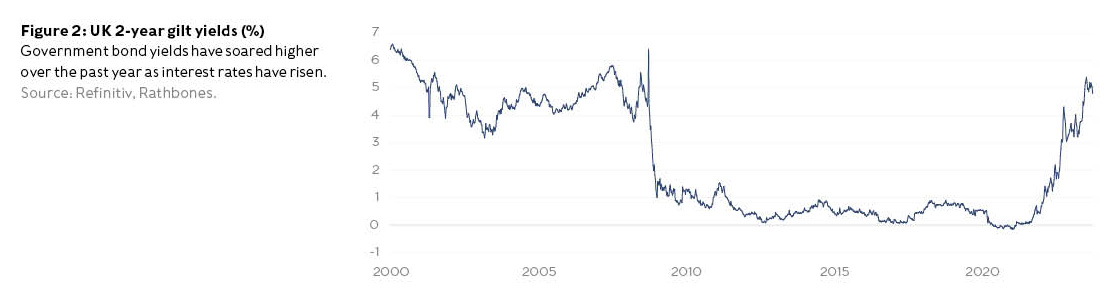
Line graph showing that UK 2-year government bond yields have soared higher over the past year as interest rates have risen

Higher volatility arguably also creates opportunities for careful active management in fixed income over the ups and downs of the economic cycle. From that point of view, gilts have recently become more attractive than they have been for a long time.

The Bank of England appears to be at the end of its cycle of raising rates. While a return to near-zero isn’t on the cards, we think it will cut rates in 2024. The previous surge is starting to affect the economy, with inflation falling and the latest business surveys pointing to activity contracting. Although wages have been growing strongly recently, the broader evidence of loosening in the labour market suggests that will not last. Meanwhile, house prices are already falling, as we discuss in the article on page 8, and consumers tend to turn cautious when that happens. In the past, interest rates have nearly always fallen in the year after house prices began to decline too. This all adds to the tactical appeal of gilts, which in past cycles have performed strongly ahead of the start of rate cuts.


VIEW PDF VERSION

Individuals and families

Individuals and families come to Rathbones for the care, diligence and intelligence they receive from their dedicated wealth management team. Begin your own investment story with Rathbones.

Let's talk
Man and woman laughing on a vespa
  1. Home
  2. Guernsey
  3. Knowledge and Insight
  4. Investment Insights Q4 2023: Higher for longer

How can we help you

In Rathbones, our clients find a trusted partner that can help guide their long-term wealth plans with reassurance, through all life stages, generation after generation. We offer you a total wealth solution, from planning to investing — our approach focuses on your wealth in its entirety.


For us every client relationship starts with trust and every investment starts with a client story. We listen to understand your priorities and aspirations to create a wealth plan and investment strategy that’s as individual as you are. You and your family can determine your level of involvement in defining your investment strategy and management — whether you prefer a dedicated Rathbones investment professional to manage the portfolio on your behalf or keep direct control of your investment decisions.

Download our brochure

Investing, growing and preserving your wealth

If you are looking for help growing your investments, our services could be right for you:


Managed
Investing in the ready-made and globally diversified portfolio that’s suitable for you. This service is typically for clients with at least £250,000 to invest.


Bespoke
A bespoke investment strategy and portfolio built and managed for you by a dedicated Rathbones investment manager. This service is typically for clients with at least £500,000 to invest.

Let's talk
two women eating in an outdoor cafe

Global perspective. Individuals focus.

The way we invest is shaped around you. To help deliver to your long-term objectives, we insist on a direct relationship with your dedicated investment manager.


We build our investments around a structure that combines clear guidance with genuine flexibility. It allows us to anticipate future needs and respond in the moment to both opportunities and challenges. 
The value of your investments and the income from them may go down as well as up, and you could get back less than you invested.

Learn about our investment approach
Group of volunteers shaking hands

Responsible investing

We offer individually tailored portfolios that reflects your client's values. We use the extensive experience of our in-house team and Greenbank which is our specialist ethical, sustainable and impact investment team formed in 1997. 

Find out more

Learn more about our services

Investment management

Looking for someone to create an investment portfolio for you?

Find out more

Greenbank sustainable investing

Looking for investments that align with your values? See our sustainable investment options.

Visit Greenbank

Asset management

Are you looking to invest in a fund? See our full range.

Visit Asset Management

Investment Insights

A twisting reel of film

3 mins

7 July 2026

Investment Insights July 2026: Stalled house prices, reshaped media, and resilient assets

Our thought-provoking monthly analysis of markets, economies, and investment opportunities and risks in particular sectors

Investment Insights July 2026: Stalled house prices, reshaped media, and resilient assets
Large red rocks reflecting in water

3 mins

8 June 2026

Investment Insights June 2026: Ageing, AI, and new investment fault lines

Our monthly look at investments, economies, and markets

Investment Insights June 2026: Ageing, AI, and new investment fault lines
Image of cat on lap

3 mins

7 May 2026

Investment Insights summary: May 2026

Our monthly look at what’s driving global markets

Investment Insights summary: May 2026
tanker terminal

3 mins

7 April 2026

Investment Insights summary: April 2026

Our monthly look at what’s driving global markets

Investment Insights summary: April 2026

Sign up for insights

Subscribe for Rathbones news, insights, and upcoming events delivered directly to your inbox.

I’ve read Rathbones’ Privacy Policy, which explains how my personal information is used, and understand that I can always unsubscribe at any time.

GA Consent trigger

Ready to start a conversation?

Make a plan with one of our experts

Your investment journey starts today
Let's talk
Rathbones Logo
  • Important information
    • Important information
    • Financial Services Compensation Scheme
    • Complaints and the Financial Ombudsman Service
    • Privacy policy
    • Accessibility
    • Cookies
    • Update cookie preferences
  • Important information 2
    • Fraud: Reporting and preventing it
    • Interest rates
    • Climate reporting
    • Corporate governance
    • Modern Slavery Statement
    • Sitemap
    • Status of our websites
Address

Rathbones Group Plc
30 Gresham Street
London
EC2V 7QN

© 2026 Rathbones Group Plc
Incorporated and registered in England and Wales.
Registered number 01000403

Follow us
  • Facebook
  • Instagram
  • LinkedIn
  • X
  • Youtube

The value of your investments and the income from them may go down as well as up, and you could get back less than you invested.