









  • Wealth Management
  • Asset Management
  • Wealth Management
  • Asset Management
Location
  • United Kingdom
    Language
  • Jersey
    Language
  • Guernsey
    Language
  • US
    Language
  • MyRathbones login
  • Financial Planning login
  • Donor Advised Fund login
Home
  • Who we help
    Who we help

    We help a wide range of clients invest well so that they can focus on what matters.

    Who we help
    • Individuals and families

      Focusing on you and your individual goals.

    • Financial advisers

      Working with you, for your clients.

    • Professional partners

      We work with lawyers, accountants and other professionals.

  • Our services
    Services

    See our wide range of services tailored for your needs.

    Our services
    • Investment Management

      Looking for someone to create an investment portfolio for you?

  • About us
    About us

    A leading UK wealth manager with roots dating back to 1742.

    About us
    • Careers

      Learn more about what it’s like to work at Rathbones, and search our current vacancies.

    • Corporate governance

      Learn more about our Board, Executive Committee and our approach to corporate governance.

    • Media centre

      Read the latest news from Rathbones Group.

    • MyRathbones – Our digital platform

      Our secure online portal and app, designed to give clients a clear view of their investments with us.

    • Our purpose

      Our driving purpose is to help more people invest well, so they can live well.

    • Responsible business

      We believe in doing the right thing for our clients and for others too.

  • Insights
    Insights

    Read the latest news and market commentary from our specialists.

    Insights
    • Investing

      Read about the key investment themes affecting global markets.

    • Responsible investing

      Explore our articles, reports and events on investing responsibly.

  • Contacts
    Contacts

    Whether you have a question about our services, or need to talk someone specific, we can help.

    Contacts
    • Our offices

      Find your local Rathbones office. We have 21 across the UK and Channel Islands.

    • Our people

      Find the contact details for your Rathbones team by searching our people’s directory.

    • Let's talk

      Our team will be in touch to help you book a no obligation consultation with an adviser.

    • Our media contacts

      Access the contact details for our media team.

    • Other contacts

      Need to contact us about something else? Here you'll find all the options.

Let's talk

SearchStax standalone input

Monthly Digest: Seasonal scares

3 November 2026

We consider ways of coping with investment risk.


John Wyn-Evans, Head of Market Analysis
  1. Home
  2. Jersey
  3. Knowledge and Insight
  4. Monthly Digest: Seasonal scares

Article last updated 3 November 2026.

Quick take

  • The global economy has held up far better than expected, in response to the Iran War. 
  • We don’t think UK interest rates will rise as much as the market expects.
  • In the AI sector, we’re avoiding the  more highly leveraged companies.

Investors are focused on three key global themes: AI, the Iran War, and monetary policy.

All are interconnected. Many market commentators and strategists attempt to isolate a single factor when attributing market moves but, in reality, the right box to tick is often the one saying “all of the above”. 

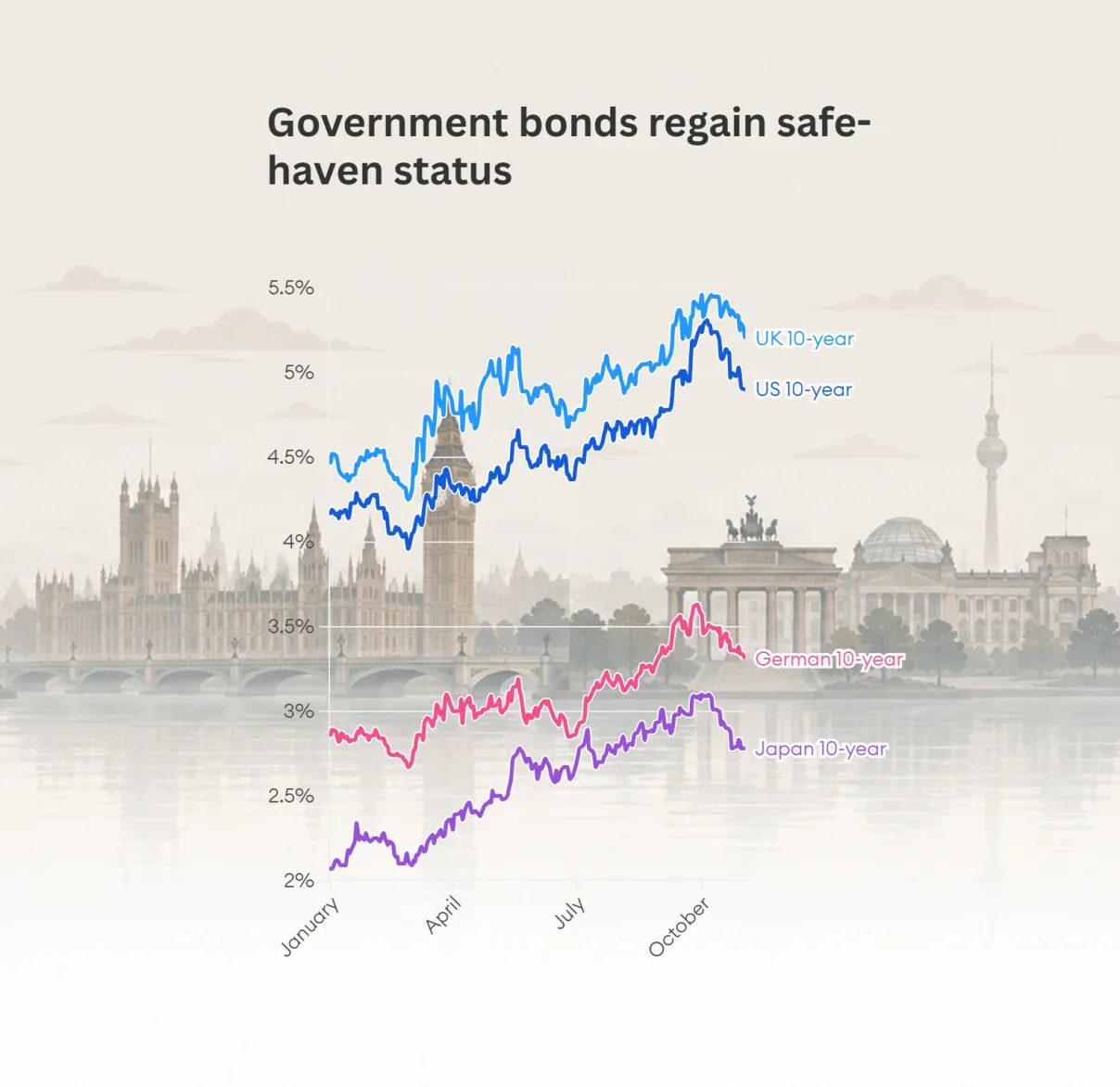
One key shift during October was the rehabilitation of government bond markets. Yields fell back (meaning that prices rose) as investors re-evaluated their ‘safe haven’ properties amidst rising concerns about the sustainability of the AI capital spending (capex) trade. There was also evidence that forced selling of bonds had pushed yields too high, at least for the current environment. Even so, with inflation remaining sticky at elevated levels and with fiscal deficits still an issue, it feels premature to signal an ‘all clear’ for bonds. 

One issue that was resolved was the UK Budget. Chancellor John Healey displayed the hoped-for safe pair of hands and market impact was limited. But difficult, and potentially highly unpopular, decisions about spending cuts lie ahead. 

Overall, balanced portfolios were little changed over the month as investors rotated within markets rather than making a wholesale exit. This was supported by a strong start to the third-quarter corporate reporting season. 


Government bond yields have fallen back as investors re-evaluate their safe-haven properties.


Iran – no resolution

With the Iran War in its ninth month, there’s a diplomatic impasse. Our game theory approach to the situation maintained that both sides would ultimately discover their pain thresholds and reach an agreement. The fact that this has not materialised before the US mid-terms is a worry. Speculation abounds that military re-escalation will occur after the election, especially if the Democrats make substantial gains.

Meanwhile, the global economy has held up far better than expected, given the rising cost of energy and related commodities. 

Much of this has to do with AI-related spending in the private sector and fiscal support in the public sector.

Suppliers and consumers have played their part, too. New routes have been found to export oil from the Middle East and strategic reserves have been tapped. 

Even so, there is only so much capacity in these reserves – and the US’ are falling towards the level where further releases would compromise the structural integrity of the vast caverns in which oil is stored. 

A resolution to the Iran War could be the single most positive driver of equities at this stage, especially if accompanied by a ceasefire in Ukraine. Unfortunately, neither can be relied upon so we need to invest accordingly.

This includes maintaining allocations to inflation-linked government bonds, as we help you invest well to live well. 


Inflation and interest rates

The global economy is much less energy-intensive than fifty years ago: it uses about a third as much per unit of output. 

But fuel costs still play a strong role in driving inflation. The headline rate of UK consumer price inflation has risen to 3.5%. 

Central banks find themselves in a difficult position. They want to head off the risk of higher inflation setting off a vicious circle of higher wage demands and even higher prices to accommodate them. But they’re aware of the depressing effect that elevated energy prices have on consumption in the rest of the economy. There is evidence that across the world, consumers are putting off consumption of durable goods as consumer prices rise – a possible drag on growth. This calls for a more measured approach. 

The US Federal Reserve has so far increased the Fed Funds rate by 0.25 percentage points, taking the upper bound from 3.75% to 4%. Market expectations are for more increases, although it’s hard to be sure of the intentions of the new Chairman, Kevin Warsh. 

The Bank of England is expected to raise the base rate by 0.25 percentage points to 4% this week. The market is pricing in as many as four quarter-point increases by September 2027, taking the base rate to 4.75%. A lot will depend on energy prices over that period, but, in our opinion, that looks too high. 
Still, we acknowledge that more central banks around the world are currently raising interest rates than since 2022. So there is a risk that the higher cost of capital will begin to weigh on economic activity. 


AI – more questions than answers

A lot of questions are being asked about the future of AI. More immediately, there are at least three major concerns for investors. 

First, will capital be available to sustain the investment boom? The US hyperscalers, the companies building data centres, maintained their spending projections during the latest results season. These total more than $1tn a year for the next three years. But with interest rates and bond yields rising, the costs are rising too. There’s also considerable competition for funds from governments, which continue to run fiscal deficits. Weaker players could be squeezed out.

Second, are there roadblocks ahead to development? These might include insufficient power or raw material supplies. We’re already seeing voter pushback influencing the mid-term elections as candidates are now vying to be the most opposed to further development in their states. And Democrat politicians may seek to apply the brakes to AI expansion should they gain control of Congress. 

Third, there’s the question of returns. Will enough users spend enough money to justify the expense of both developing the frontier models and providing the computing power to use them? 

A recent paper by Stijn van Nieuwerburgh, a Professor of Finance at Columbia Business School in New York, casts doubt on the outcome. By his calculations, this fledgling industry will have to be generating annual revenue of $3.5tn by 2032 to make a (still slightly underwhelming) 10% return on capital. 
That’s equivalent to around 8.5% of US GDP. And that’s just for the US players.

We still see AI as a paradigm-shifting technology that  will enhance productivity in ways that we cannot even currently imagine. Even so, we’re cognizant of the risks and are spreading our exposure broadly across hyperscalers, chip manufacturers, and ‘picks and shovels’ suppliers, as well as investing in companies that might benefit from the adoption. The healthcare industry, for example, is a potential winner – look out for the next edition of our Investment Insights magazine, which covers this. We also eschew the more highly leveraged companies that are almost solely reliant on increasing amounts of debt to fund their ambitions. In the AI space, these are the so-called ‘neoclouds’. And we maintain allocations to government bonds as a counterweight to the risk that AI-related growth disappoints. 

Download a PDF of this article

Recent economic highlights

The UK flag

UK

The Budget came and went without leaving a noticeable impression on broader financial markets. This is a good outcome. Ever since the infamous 2022 ‘mini’ Budget, which hastened the departure of Prime Minister Liz Truss from 10 Downing Street, Chancellors of the Exchequer have been at great pains not to cause further upsets, especially to bond markets.

Healey’s speech was a masterclass in low-impact policymaking. Despite unveiling a record number of individual initiatives, the net impact on the country’s finances was the fourth lowest of all financial statements delivered since the Office for Budget Responsibility was created in 2009.

All well and good, then? Not necessarily. Although the projections for our annual deficit continuing to fall through the end of the decade look encouraging, they assume some spending cuts that might never be implemented.

There’s also the not insubstantial sum of £10bn to be found to reach the 2030 Defence spending target of 3% of GDP (rising to 3.5% by 2035). Welfare and benefits spending is, apparently, in Healey’s sights, but backbench Labour MPs have already seen off one Prime Minister and Chancellor combination who tried to reduce that. 

Against this background, the UK economy has rumbled on impressively – well ahead of economists’ expectations. GDP growth is running second-fastest only to the United States amongst the G7 countries (although that might say more about their weaknesses). The pound has just risen to levels (on a trade-weighted basis) not seen since the morning after the Brexit referendum. 

The FTSE 100 Index gained 1.3% in October, outperforming global equities by almost 4%. A heavy weighting in Energy and Consumer Staples provided a positive counterbalance to markets more exposed to concerns about the AI buildout. UK equities might not always offer the best future returns but can play a valuable role in diversifying portfolios away from certain types of risk.
 

The United States flag

US

The headline S&P 500 Index returns for October tell a story of relative calm, posting a total return of -0.87%. Once again, though, there was considerable churn below the surface. Although the index was weighed down by AI-related concerns surrounding the mega-cap technology companies, the undercard was stronger: the equal-weighted version of the S&P 500 (in which the smallest company, News Corp, has as much influence as the largest, Apple) gained 5%. An even larger gap is visible between the Philadelphia Semiconductor Index (-15.3%) and the S&P 500 Ex-AI Enablers custom index (+7.8%). That was pretty much the reverse of what had happened since the end of July (the end of the previous AI sell-off), which in itself regained the ground lost since the beginning of June.

It should be clear from this that the investment community is struggling to reach a conclusion, and share prices can be sharply pushed around by the latest narrative or the loudest voice. This could continue for some time, and we should be prepared for more price volatility. 
In the midst of this, corporate America continues to post strong earnings growth, which will come in around 30% higher for the third quarter versus a year earlier. Yes, a lot of this is attributable to tech/AI, but it also looks as though the rest of the pack is growing earnings well into double digits. Hence the rotation within the market rather than blanket selling. 
 

The European Union flag

Europe

Social unrest has hit the headlines, with disruption spreading from France to Italy, Spain and Portugal. This reflects, at least to some degree, dissatisfaction with low levels of growth and investment, especially as displayed by younger citizens who appear to be losing hope in terms of aspiring to, for example, home ownership and household formation. Even in Spain, which has actually seen higher growth than most of its eurozone peers.

A good dose of strong, productivity-led growth delivering higher real incomes would be an excellent antidote but it’s hard to see where that comes from quickly. Investment in AI could be the catalyst but, equally, it threatens to reduce employment opportunities for many. Europe remains highly exposed to rising energy prices, with wholesale natural gas prices having risen three-fold since the eve of the Iran War. 

The European Central Bank will play a pivotal role in navigating this period. At its last meeting, it decided to hold the deposit rate unchanged at 2.5% but suggested it was on track to resume tightening policy should energy prices remain elevated. Futures markets suggest another quarter-point increase in either December or January, followed by a further one by mid-2027. This would be to head off the risk of so-called ‘second round’ inflation, when consumers demand higher wages to compensate for higher prices. 

The ECB might also hold the key to calming nerves in the French government bond market. 10-year OAT yields rose above 5% for the first time since 2002 in the face of political strains. These include the inability to pass a budget in the split parliament and the strong prospect of Marine Le Pen of the far-right National Rally Party becoming President next year. Crucially, France’s cost of debt relative to that of Germany’s has risen to levels last seen during the euro zone crisis in 2011.
 

An icon for emerging markets

Emerging markets

Our commentary has recently highlighted the correlation between emerging markets and the technology-heavy US Nasdaq Index. October maintained the trend. Tech-influenced markets such as South Korea, Taiwan, China, and Hong Kong all suffered losses. Indian equities rose slightly. The greatest volatility was seen in Latin America, notably Brazil. The Ibovespa Sao Paulo Index jumped 12% when it looked as though right-wing Presidential candidate Flávio Bolsonaro was going to win the election. It then dropped 20% when incumbent left-wing President Lula da Silva prevailed in the second round. The country has a 98% debt-to-GDP ratio and is running an annual fiscal deficit of 8%, both very high by normal EM standards. Bolsonaro offered much-needed fiscal consolidation. Lula is likely to remain profligate. 

An icon for fixed income with a vault and a stack of coins

Fixed income

The Bloomberg Global Aggregate Bond Dollar Index rose 1.4% in October and so far this year has returned -1.3%. The sterling-hedged version returned +1.7% and +0.2% respectively. This eventual steadying of returns is welcome as it now allows asset allocators to contemplate the use of sovereign bonds as risk diversifiers in a balanced portfolio. We have pointed out for a while that the yields currently available can do a lot to protect holders from losses on a total return basis even if those yields rise further (although inflation protection might be less achievable without holding index-linked bonds). The market showed its hand in October as bonds performed well on days when concerns about growth increased. This is a classic ‘safe haven’ characteristic.

Even so, we aren’t getting carried away. Lower growth would undermine tax revenue at a time when benefits payments were rising, thus increasing deficits and debt piles. Bearing that in mind, we’re keeping the length of maturity of bonds on a pretty tight leash so as to minimise potential losses in the event of some sort of fiscal-led bond market crisis. 

The All-UK Conventional Gilts Index delivered a total return of +0.5% over the last three months and -0.6% over the past year. Index-linked gilts returned +2.8% and +0.2% over the same respective periods. Emerging market bonds produced a total return of +0.7% in sterling over the three months to end October (+12.7% over 12m). Global high-yield bonds delivered -1.3% (+1% over 12m) in sterling terms.
Bond values can fall when interest rates rise. The creditworthiness of a bond issuer may also affect the value of an investment.
 

More markets analysis

John Healey walks in front of Number 10 Downing Street

5 mins

28 October 2026

What does the 2026 UK Autumn Budget mean for the economy?

We look into the impact of John Healey's inaugural Budget.
What does the 2026 UK Autumn Budget mean for the economy?
Sunset behind a plane on tarmac

5 mins

6 October 2026

Industrials: a hesitant recovery meets an investment boom

Cleared for take-off? The investment case for industrials rests on a recovery with room to run.

Industrials: a hesitant recovery meets an investment boom
Tribune for congressman or US minister political speech

5 mins

6 October 2026

US mid-terms: what investors need to know

Breaking with convention: Investors’ old assumptions about US mid-terms may no longer hold.

US mid-terms: what investors need to know
Close up of a US dollar

3 mins

6 October 2026

AI, industrials, and US mid-terms: Investment Insights October 2026

Our thought-provoking monthly analysis of markets, economies, and investment opportunities and risks in particular sectors

AI, industrials, and US mid-terms: Investment Insights October 2026
Access all our insights

Sign up for insights

Subscribe for Rathbones news, insights, and upcoming events delivered directly to your inbox.

I’ve read Rathbones’ Privacy Policy, which explains how my personal information is used, and understand that I can always unsubscribe at any time.

GA Consent trigger

Ready to start a conversation?

Make a plan with one of our experts

Your investment journey starts today
Let's talk
Rathbones Logo
  • Important information
    • Important information
    • Financial Services Compensation Scheme
    • Complaints and the Financial Ombudsman Service
    • Privacy policy
    • Accessibility
    • Cookies
    • Update cookie preferences
  • Important information 2
    • Fraud: Reporting and preventing it
    • Interest rates
    • Climate reporting
    • Corporate governance
    • Modern Slavery Statement
    • Sitemap
    • Website status and updates
Address

Rathbones Group Plc
30 Gresham Street
London
EC2V 7QN

© 2026 Rathbones Group Plc
Incorporated and registered in England and Wales.
Registered number 01000403

Follow us
  • Facebook
  • Instagram
  • LinkedIn
  • X
  • Youtube

The value of your investments and the income from them may go down as well as up, and you could get back less than you invested.

Wealth Management

You are leaving the {source} website
You are leaving the Rathbones {source} website and entering the Rathbones {destination} website.
Products, services and regulatory protections may differ between jurisdictions.
Would you like to continue?