







  • Wealth Management
  • Asset Management
  • Wealth Management
  • Asset Management
Location
  • United Kingdom
    Language
  • Jersey
    Language
  • Guernsey
    Language
  • US
    Language
  • MyRathbones login
  • Financial Planning login
  • Donor Advised Fund login
Home
  • Who we help
    Who we help

    We help a wide range of clients invest well so that they can focus on what matters.

    Who we help
    • Individuals and families

      Focusing on you and your individual goals.

    • Entrepreneurs and business owners

      Helping turn the success of your business into financial security for your family.

    • Financial advisers

      Working with you, for your clients.

    • Charities

      Helping charities invest in line with their mission and values.

    • Professional partners

      We work with lawyers, accountants and other professionals.

  • Our services
    Services

    See our wide range of services tailored for your needs.

    Our services
    • Investment Management

      Looking for someone to create an investment portfolio for you?

    • Wealth Management

      Our combined investment and planning service for a holistic approach to your finances.

    • Financial Planning

      Need help reorganising your finances and planning for the future?

    • Asset Management

      Looking to invest in a fund? See our full range.

    • Tax, trust and legal services

      Structure your wealth for the future by bringing together legal, tax, family, and investment considerations.

    • Greenbank Sustainable Investing

      Looking for investments that align with your values? See our sustainable investment options.

    • Personal Injury and Court of Protection

      Rathbones’ dedicated personal injury (PI) and Court of Protection (COP) team.

    • Private Office

      Helping clients with £5m or more to protect, grow and structure their wealth for the long term.

    • Private Banking with Investec

      Private, corporate, and investment banking services through our partnership with Investec bank.

  • About us
    About us

    A leading UK wealth manager with roots dating back to 1742.

    About us
    • Careers

      Learn more about what it’s like to work at Rathbones, and search our current vacancies.

    • Corporate governance

      Learn more about our Board, Executive Committee and our approach to corporate governance.

    • Investor relations

      Find the Rathbones Group Plc financials, reports, investment case and key events.

    • Media centre

      Read the latest news from Rathbones Group.

    • MyRathbones – Our digital platform

      Our secure online portal and app, designed to give clients a clear view of their investments with us.

    • Our purpose

      Our driving purpose is to help more people invest well, so they can live well.

    • Responsible business

      We believe in doing the right thing for our clients and for others too.

    • Awards

      Our awards and industry recognition reflects our commitment to exceptional wealth management.

  • Insights
    Insights

    Read the latest news and market commentary from our specialists.

    Insights
    • Financial planning

      Explore a range of topics affecting your finances, from retirement planning to the latest legislative changes.

    • Investing

      Read about the key investment themes affecting global markets.

    • Podcasts

      Listen in to or watch our specialists in one of our podcasts.

    • Responsible investing

      Explore our articles, reports and events on investing responsibly.

    • Webinars

      Timely insights, real conversations. Watch live or catch up anytime.

  • Contacts
    Contacts

    Whether you have a question about our services, or need to talk someone specific, we can help.

    Contacts
    • Our offices

      Find your local Rathbones office. We have 21 across the UK and Channel Islands.

    • Our people

      Find the contact details for your Rathbones team by searching our people’s directory.

    • Let's talk

      Our team will be in touch to help you book a no obligation consultation with an adviser.

    • Our media contacts

      Access the contact details for our media team.

    • Other contacts

      Need to contact us about something else? Here you'll find all the options.

Let's talk

SearchStax standalone input

Weekly Digest: Junk

17 November 2026

The history of junk bonds offers lessons for investors in 2026, although history tends to rhyme rather than repeating exactly.


John Wyn-Evans, Head of Market Analysis
  1. Home
  2. Knowledge and Insight
  3. Weekly Digest: Junk

Article last updated 17 November 2026.

Quick take

  • It’s important to pay close attention to cash flow, as opposed to just headline earnings. 
  • Higher interest rates could prompt highly indebted ‘neoclouds’ to rein in spending, presenting risks for memory chip suppliers and the companies behind the buildout of AI computing capacity. 
  • Digging back into financial market history always offers useful lessons for investors.


Of all the phobias, irrational fear of all things associated with the number thirteen (triskaidekaphobia) seems one of the odder ones. Spiders and snakes, maybe. Narrowing it down to fear of a certain date, Friday the 13th, produces an even longer name: paraskevidekatriaphobia.

But Friday the 13th seems to have a funny habit of delivering on its threat. A quick search reveals all manner of unfortunate events that have taken place on that date, ranging from plane crashes to the bombing of Buckingham Palace during World War Two. But then, history is full of unfortunate events – and a statistically rigorous assessment would doubtless show that Friday the thirteenth is no more unfortunate than any other date. 

That said, on Friday, 13 October 1989, we saw an early incident of a computer virus causing widespread disruption – the ‘Jerusalem virus’, actually set up to cause trouble on Friday the 13th (into its second year, in 1989). We also saw a stock market mini-crash in the US: the S&P 500 index fell 6.1% in a single day. I remember it clearly, as I was working in the US at the time. It was blamed on the collapse of a proposed leveraged buyout of United Airlines (UAL) by its management and employees. Compared to the sums of money being thrown around today, the $6.75bn valuation placed on the deal seems laughably small, but it was big for its time – and companies’ share prices in general had been buoyed, among other things, by the chance that takeover offers priced at a premium to the current stock value. 

Most importantly, the failure of this deal presaged the end of a lucrative takeover boom built on increasing levels of debt, initially thanks to the Federal Reserve Bank’s (Fed’s) cut in interest rates in response to the stock market crash of October 1987. At the same time, the Fed had also signalled its intent to shield investors from extreme market volatility, a message that encouraged more speculative behaviour. This found its era-defining outlet in the market for junk bonds - bonds deemed insufficiently safe to merit ‘investment-grade’ status.  


A new era

Junk bonds, in their earliest guise, were investment-grade bonds issued by companies that had run into financial difficulties. When a company’s bonds lose that rating, they’re known as ‘fallen angels’. The most famous example of such a fall from grace involved the Ford Motor Company in March 2020, when the pandemic pushed its finances over the edge. I’m happy to report that it has since regained investment-grade status. 

A canny Wall Street financier (and legend, despite his various run-ins with the law), Michael Milken, is credited with developing the junk bond market in the 1970s as a place to raise capital for companies whose finances would not merit investment grade, but which might offer higher returns to investors willing to take on more risk. He also worked out that the more issuance there was, the greater the ability of investors to diversify their risk across a range of industries and companies. This led to a lower probability of a bond portfolio being wiped out by a single default. In other words, there were strong incentives for both borrowers and lenders to expand the market. 

To begin with, the bulk of the new money was raised by companies that wished to invest capital in their existing businesses but were deemed too risky by banks. As interest rates fell during the 1980s and the economy expanded, a new breed of issuer emerged. This is the corporate raider: an investor who issues debt to acquire companies – sometimes debt issued by the companies themselves – and make a profit from restructuring them’. This group is also populated by names that have become part of Wall Street history (again, not without controversy), including Carl Icahn, T Boone Pickens, and Ivan Boesky. Another, Nelson Peltz, is still going strong today as an ‘activist’ investor. 

Such big characters were source material for the character of Gordon Gekko in the culturally iconic film Wall Street, released in 1987. Although the film was intended by director Oliver Stone to be a cautionary tale of what happens to those who fall prey to greed, audiences viewed it as a celebration of excess. It set a tone for risk-taking for the rest of the decade – not to mention a penchant for wearing braces! 

The excesses did not go unnoticed by the Fed, which started to raise interest rates again in March 1988. To give some context, the first increase was from 6.5% to 6.75% – a lot higher than rate today. They eventually reached 9.75% in February 1989, so it’s unsurprising that companies reliant on debt  began to struggle. But market cycles have a habit of surviving beyond their sell-by date, driven by their own momentum, and the last deals of the buyout boom were done at increasingly stretched valuations with little room for disappointment. The failure of the UAL deal was a message that capital would be much less easily available for such enterprises. 

The UK was swept up in the fever too. Household names such as Gateway (supermarkets), Magnet & Southern (kitchens), MFI (furniture) and Wickes (DIY and building materials) were bought out in leveraged deals. None fared particularly well from an investment perspective. 
We also had our own corporate raiders, the most famous being Lord Hanson of the eponymous Hanson Trust. The Wall Street character Sir Larry Wildman is generally viewed as inspired by Sir Gordon (later Lord) White, who ran the highly acquisitive US arm of Hanson Trust. The company’s logo was intertwined Stars and Stripes and Union flags. The rise and fall of the great British conglomerates (including Hanson, BTR, and Tomkins) merits a review of its own. Let’s just say that there was some interesting accounting involved. The existence of such practices is a good reason why we pay very close attention to cash flow, as opposed to just the headline earnings. 


Stars and hikes

The US benchmark interest rate's recent peak is far below 1970s and 1980s highs.


Payback time

As for the US stock market, having peaked on 10 October 1989, it failed to make another meaningful advance until February 1991, even though the Fed cut interest rates to 6% again in the interim. This is because a lot of excess, in the form of overvalued stocks and large amounts of debt, had to be worked out of the system. 

The fact that we started by looking at Friday the 13th is a red herring, even if last week’s example brought us a widespread outage of Microsoft’s Outlook email software and a massive failure of the US air traffic control system. The human mind is all too ready to confuse correlation with causation. This leads to all sorts of misapprehensions, to which we, as investors, must always remain alert. 

But we can draw a line from the late 1980s to the present. The junk bond market is alive and well, although now rebranded as the more alluring ‘high-yield’ bond market. It’s still an important venue for raising buyout funds.

This market has also been used more recently to fund certain elements of the AI buildout, notably by neoclouds, which rent out to customers the servers and chips that make the use of AI possible. If rising interest rates and uncertainty over future demand for computing power persist, investors could withdraw capital from this market or at least demand an interest rate that makes the finances less viable. Although we tend to steer clear of more highly leveraged companies, any slowdown in their growth can have effects all along the supply chain. We’re currently reassessing what this means for both suppliers of memory chips and the ‘picks and shovels’ companies behind the buildout of AI computing capacity. 
 

This information reflects our general views and should not be taken as a recommendation or advice as to how any specific market is likely to perform. The value of investments can go down as well as up and you could get back less than you invested.

Download a PDF of this article

Recent economic highlights

The UK flag

UK

The UK economy continues to display resolute strength. GDP grew by 0.2% in September month-on-month, with the annual figure coming in at 1.9%. There seems to be a healthy contribution from professional & business services, which might be AI/tech driven. There’s certainly growing evidence of a greater propensity to invest. September’s employment data was a more mixed bag, even if the unemployment rate fell from 4.7% to 4.6%. That was based on the Labour Force Survey measure showing a net new 155k jobs created over the last three months. However, all data from the Office for National Statistics remains under question at the moment. Data taken from payrolls (as per PAYE) suggests a loss of 34k jobs in October. Overall, taking in both data sources, employment looks flat. The silver lining, from an interest rate perspective, is that private sector wage growth remains subdued at 3.1%. This is seen as consistent with inflation returning to 2%, although much still depends on future energy prices. This could hold the Bank of England back from too many base rate hikes – certainly not the near-5% level (vs 4% today) that’s priced in by futures markets. 

The United States flag

US

Investor confidence was shaken last week by a ‘hot’ inflation print. Headline consumer price inflation was 0.4% month-on-month in October, above the expected 0.3%. There was no annual figure published because data was not collected in October 2025, owing to a government shutdown. However, estimates for a separate measure of inflation based on personal consumption indices suggest that prices are rising at around 3.9%, still well above the Fed’s 2% target. This triggered a big shift in interest rate expectations last week, especially as the inflation numbers were accompanied by hawkish comments from a couple of Fed governors, notably Chris Waller, who floated the possibility of a 50 bp rate hike at December’s meeting. The probability of a 25bp rate rise jumped to 109% (one rise and some chance of another one) from 75%. There are now more than three quarter-point increases priced in over the next 12 months, vs fewer than two just a week ago.  

The European Union flag

Europe

The ZEW Economic Sentiment Index bounced back to 26.5 in November from 18.5 in October. Respondents seem to have reacted favourably to the US midterm election results – especially to increased hopes, following the results, of a resolution to the US war with Iran. This sent the oil price down sharply, helping Europe, as a big net importer of oil and gas. Lower energy prices would relieve the pressure on the European Central Bank to increase interest rates further. The assessment of current conditions was unchanged but still stands at recent highs, with AI investment and higher defence spending supporting the industrial sector. The second reading of Q326 GDP growth confirmed the initial figure of 1.3% year-on-year. 
 

The People's Republic of China flag

China

China’s monthly data release was another disappointment, coming in below expectations on every metric. Retail sales in October increased just 0.4% year-on year. Households remain unwilling to increase spending, especially with house prices still falling and residential property sales very weak. Property investment is running 21.6% below the levels of a year ago. High-tech exports are the economy’s main redeeming feature. This led to annual industrial production growth of 4.8%, although that was still lower than the expected 5.3%. A planned government-funded increase in infrastructure spending is unlikely to make households feel much better. 

Download a PDF of this article

Additional recent analysis

medical lab image

5 mins

9 November 2026

Pharma’s changing formula: article with interactive table

New treatments and AI offer hope amid pricing and patent pressures.

Pharma’s changing formula: article with interactive table
Japan apprentice geishas with smartphone

4 mins

9 November 2026

Made in Japan

The country has much to offer in the age of AI.

Made in Japan
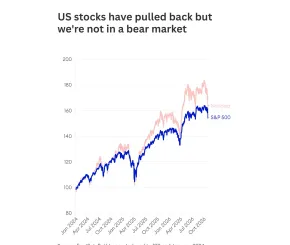
Line graph showing US stocks pulling back from highs

5 mins

6 November 2026

A sharp fall, not yet a change of course

We’re poised to react to the recent market turbulence – but warn against over-reaction.

A sharp fall, not yet a change of course
Robert Sears headshot

14 mins

6 November 2026

Investment update video: The market beneath the market

What's really moving markets? Join our Chief Investment Officer, Robert Sears, for a 14-minute look beneath the headlines, from how AI is being financed to whether bonds are protecting portfolios again.

Investment update video: The market beneath the market
Open our hub of knowledge and insight

Sign up for insights

Subscribe for Rathbones news, insights, and upcoming events delivered directly to your inbox.

I’ve read Rathbones’ Privacy Policy, which explains how my personal information is used, and understand that I can always unsubscribe at any time.

GA Consent trigger

Ready to start a conversation?

Make a plan with one of our experts

Your investment journey starts today
Let's talk
Rathbones Logo
  • Important information
    • Important information
    • Financial Services Compensation Scheme
    • Complaints and the Financial Ombudsman Service
    • Privacy policy
    • Accessibility
    • Investor relations centre
    • Cookies
    • Update cookie preferences
  • Important information 2
    • Fraud: Reporting and preventing it
    • Client help hub
    • Interest rates
    • Climate reporting
    • Corporate governance
    • Modern Slavery Statement
    • Sitemap
    • Website status and updates
Address

Rathbones Group Plc
30 Gresham Street
London
EC2V 7QN

© 2026 Rathbones Group Plc
Incorporated and registered in England and Wales.
Registered number 01000403

Follow us
  • Facebook
  • Instagram
  • LinkedIn
  • X
  • Youtube

The value of your investments and the income from them may go down as well as up, and you could get back less than you invested.

Wealth Management

You are leaving the {source} website
You are leaving the Rathbones {source} website and entering the Rathbones {destination} website.
Products, services and regulatory protections may differ between jurisdictions.
Would you like to continue?