Video transcript
Speakers
- Gemma Gooch – Head of Charities Distribution, Rathbones
- Will Mcintosh-Whyte – Fund Manager, Rathbones
- Olivia Marlow – Senior Investment Director, Charities, Rathbones
- Kate Elliot – Head of the Responsible Investment Centre of Excellence, Rathbones
- John Wyn-Evans – Head of Market Analysis, Rathbones
Transcript
Introduction
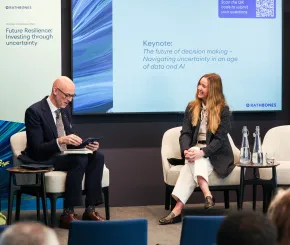
Gemma: Turning to the next session, the world ahead, markets, geopolitics and what it means for charities. So that can sometimes feel like something that happens in the news at a distance from the day job, and it very much isn't. Given the rollercoaster we've seen in the bond market over the last few weeks, or the musings from the White House, these things land squarely on the decisions that many of you in this room have to make, and we understand that. What your reserves are really worth, what you can afford to commit this year or next year or years ahead, and how much risk your trustees can tolerate. So, I'm going to introduce Will Mcintosh-Whyte, who is fund manager of Rathbones Multi-Assets team, and he is going to begin with a presentation around the forces shaping the years ahead before we move into a panel discussion with our expert Rathbones investors on what the changing environment means for charity portfolios. Will, over to you.
The risks facing charitable missions
Will: Good afternoon. Thank you very much for joining us today. We're going to start with a question. So hopefully you've all scanned and you're on the Slido app. So if you could get that up, I'm going to ask our first question of today, which is, what do you see as the biggest risk to meeting your charitable mission? And on there we have rising operating costs, economic uncertainty affecting investments, changes in government policy, regulation or public sector funding, increased demand for services exceeding your capacity, or difficulty attracting or retaining skilled staff or volunteers.
I hope you can get your answers up there, and it will give us a good insight into some of the challenges that you're facing right now. That's coming up live. I didn't realize it was so fancy.
All right. Well, it's definitely a mix of things, but certainly it looks like inflation is a key part of that and of course, government as well. I'm sure we'll come back to that and explore some of those answers in full in due course. Now, the purpose of today – not quite there yet. The purpose of today is not to predict short-term events. I'm not going to stand here and talk about where the oil price is going or what's going to happen in the midterms, and I'm certainly not going to try and second guess what Mr. Burnham has in store for us in the Autumn Budget.
Three forces shaping the years ahead
But instead, what I want to do is focus on some of the longer-term structural forces that we see reshaping economies right now and driving investment markets and investment opportunities over the next five to 10 years. And also touch on what that means for you and your charities as you look to preserve purchasing power and support spending and funding your charitable mission. So the three themes I'm going to talk about today are AI, both the build-out and the adoption of artificial intelligence. You certainly can't have missed artificial intelligence.
Certainly been in the news quite a lot lately. We'll talk about the strategic fragmentation that we are seeing across the world as the world polarises and globalisation goes into reverse. We'll talk about the fiscal strain as well that we are seeing around the world as governments struggle with rising debt loads and struggling to rein in their overspending. And these things really are almost tectonic plates. Each is interacting and moving the other, and they are generally moving how economies are behaving, and we are increasingly seeing that in capital allocation decisions. Now, each of these themes, it comes with its own risk.
They come with their own risks. You've got the oil price – oh, sorry, and there are lots of other risks out there as well, some of which John alluded to. So you've got the oil price touching around $100. Bond yields are back to levels we've not seen really since the global financial crisis. And potentially a little more concerning are the supposed 10% chance that AI is going to bring upon the end of humanity.
So marketing were not overly happy with me putting this slide in. It's not very on brand. But it does make an important point. Actually makes a couple of important points. And one is, yes, markets are often efficient, but yes, they can also be complacent as well. However, there are always short-term issues facing markets. There are always setbacks that we can see in markets. There are plenty of risks of those out there right now. However, not all of those always come to pass. Often, they just burn up in the atmosphere.
Building the infrastructure for AI
And I think the important thing to remember as charities is you are long-term investors. You are actually really the original long-term investors. So it's important to stay invested. There are going to be these temporary setbacks, but it's important to essentially look at what is a temporary setback and what are, more importantly, those long-term structural drivers that you need to invest behind, and they are the things that are going to drive your investments higher and allow you to preserve that spending power over the longer term. So getting onto the first of our themes, AI, artificial intelligence. To say something I don't think you could have missed over the last three years, which AI sort of came into being, if you like, in a public sphere when ChatGPT was launched publicly in 2022. And we look at AI, and we generally think this is looking like it could be a transformational technology, in the same way we saw with electricity, and same way we saw with the internet or the smartphone. And just like some of those transformational technologies at the start, it's not always obvious who the ultimate long-term winners are going to be.
If you take the internet, it was certainly not obvious that a small online bookseller was going to become such an important part of our lives. I can feel another parcel turning up to my house as we speak. They seem to come daily, as I'm sure they all do to your houses. Google hadn't even been invented at the onset of the internet, and it is now essentially like a verb to us. Netflix, if you got Netflix in 2000, was still posting us DVDs. And of course, we have social media.
Certainly 25 years ago, I don't think any of us would have predicted we would spend more time scrolling cat videos than watching TV. So things do change. Things change quickly. It's not always obvious, as I say, who the winners are going to be over the longer term. What I think is reasonably obvious right now is who the winners are in AI right now, and it is in the infrastructure of artificial intelligence. You have data centres that are the backbone of artificial intelligence on which we train models and artificial intelligence essentially runs.
And these data centres are huge. To give you a concept, I use AI to give you some kind of idea of how big they actually are. And one that is being built in Texas is four times the size, its footprint is four times the size of Heathrow Airport. So I think that gives you a vague understanding. If you look at a London map, you can see Heathrow Airport. It's a fairly big chunk of London. It's four times the size of that. So these are serious investments. And companies, and it is really just a handful of companies, are spending hundreds of billions of dollars, if not getting towards a trillion, building out these data centres, building out the infrastructure on which artificial intelligence is going to run. And within those data centres are a huge number of inputs that are required, whether that is chips, whether that is the networking, the servers that go in there, the connectors that go in there.
There's cooling equipment that needs to go in there. There's a whole power and energy complex that goes around the data centre as well because they are incredibly power-hungry. And for us, the opportunity is right now we're the recipients of those hundreds of billions of dollars, and whether that's NVIDIA, who design these chips, which are absolutely imperative for artificial intelligence to function, whether that's TSMC, which is the world leader in making these chips, ASML, they make the machines that make the chips. We have Arista, they do the networking.
Amphenol, they do the connectors. And then names like Siemens Energy and Schneider Electric, which are facilitating the power consumption element to the artificial intelligence story. So we think there are really interesting opportunities there over the next few years as the infrastructure continues to be built out and these companies continue to build, grow, and compound their earnings. Now as we move from that infrastructure side, we move into sort of an adoption stage, and that has already started to a certain extent. A bit of audience participation. Is anyone using AI in their daily lives right now?
Moving from infrastructure to adoption
That is the vast majority. And if you're using it in your capacity as a trustee?
Slightly less. I have to say, we've certainly noticed it in some of the RFPs we are getting. So certainly some of you are using it, I'm certainly sure of that. So we're in this adoption phase, but we are still relatively early on. So if you look at the percentage of a company's operating costs on average and what they're spending on AI, it's still less than 1%. So there is a lot of runway to go. And we generally feel that companies are adopting it, they're implementing it, and embedding it into their businesses.
It's driving productivity. It's helping to reduce costs. In an increasing number of cases, it is also helping to drive the revenues of these companies. So the adoption phase is well into the swing of things. And then, of course, what comes next? Well, this is where I think it's going to be very important to stay active. The winners, I think, will emerge, and the important thing will be to start to identify them early, back them early, and that will help to drive our portfolios higher over the longer term.
From efficiency to resilience
So moving on to resilience. Efficiency, no longer a core objective. So if you think about where we've come from really for the last 30 years or so, globalisation was the name of the game. It was just-in-time inventory management. And it was – Sorry, it was just-in-time inventory management. And it was all about driving costs down. And we've moved very much away from that, where efficiency has become much more important. And actually, the sort of sovereignty and control has become much more important. And you can see that in artificial intelligence is just one strand of this. If you listen to the rhetoric coming out of the US, they are very much about winning the race against China.
They want that technological sovereignty because they see it giving them an economic advantage and an advantage through military supremacy as well. And so that is why they're encouraging companies to innovate on their models and build out the data centres on which artificial intelligence is likely to run. But we're seeing this move to efficiency not just around technology, it's also energy security, whether that is investment in renewables by Europe as they look to sort of reduce their reliance on fossil fuels, whether that is America looking to other parts of the world to help it navigate this energy security issue.
And certainly from an infrastructure perspective, as we move towards electrification and AI comes online, which uses so much power, the grid is not ready for this. The grid was already struggling. There's not been enough investment in electricity grids around the world. And we're starting to see governments recognise that and encourage investment into electricity grids in order to provide that extra sort of reliability that these countries are going to need. And we're seeing it not just at the company, the corporate – not just at the sovereign level, but also at the corporate level.
And I think this is where it almost all began when Trump came in, Trump 1.0, and started bringing in tariffs, encouraging America to build and produce in America. And then, of course, we ran into COVID, which I think really highlighted how fragile global supply chains can be when you see this element of disruption. Of course, we now have Trump back in, again affecting a large number of tariffs, and that is encouraging companies to either produce in America or certainly, we call it nearshoring, where they are producing close to where their end markets are. So you are seeing if your end market is in America, maybe you're producing in Mexico. If your end market is in Europe, maybe you're producing in Romania. To again, provide that element of resilience to shorten those supply chains. You're seeing dual sourcing in supply chains, so you're not just reliant on one provider as well. And you are very much seeing this sort of security, this resilience becoming key drivers of economic policy.
Where capital is being allocated
And as those priorities change, so capital follows. So you can look at defence, where obviously we're seeing increased defence spend. You have seen something like a 50% increase in defence budgets around the world just over the last five years. Cybersecurity, again, from a sovereign and corporate perspective, becoming increasingly important. And you're seeing 15% annual increase in cybersecurity spend around the world. You only need to look at the daily headlines to see why, particularly with the onset of AI, why cybersecurity is going to be so important.
That grid infrastructure that I mentioned, that power demand is increasing with electrification, with electric cars, with AI. And so lots of money is going into that space as companies, as governments spend on that space, but they also provide things like tax breaks in order to encourage investment into that side. And sometimes it's just a case from a regulatory perspective as allowing companies to make a return on their investment. So ultimately, it's something that you and I will all be paying for. now industrial automation. Of course, if you are going to reshore or onshore or nearshore or build a new manufacturing facility, in many cases now, companies are looking to automate those factories as they look at, over the long term, the likely labour shortages that we may have. And then there's that domestic manufacturing piece that I mentioned, whereby any industry that is viewed as strategically important is being encouraged to produce at home.
that is why the US passed things like the CHIPS Act, where it's providing hundreds of billions of dollars to encourage companies to build chips at home. And you're seeing that not just across the technology spectrum as well, but through commodities and anything ultimately, that can make a country vulnerable if they are not producing it at home. Of course, there's a cost to all of this. That bill for resilience is rising. whether it is the AI buildout, which is costing the US taxpayer because there are significant tax breaks to building these data centres.
The rising cost of resilience
you're seeing massive amounts of issuance from these large tech players as they look to fund the data centre rollout. defence, clearly, as we know, defence budgets are under pressure, but yet governments are lifting them regardless because they recognise there is war on the doorstep of Europe, there is war in the Middle East. and then, of course, there is aging populations. we have this wall of people headed into retirement, getting older, where they're going to require much more healthcare and welfare, and that is going to continue to push up the bill for governments who are already under pressure.
the percentage of debt to GDP, touching 100%. That 99 trillion was at the end of nine – 2025. it has now gone well through that. and of course, all of these issues, they impact each other. so as you see defence, that defence spend go up, it puts pressure on government balance sheets. Just ask, the Chancellor right now, who, of course, infamously resigned from his position as Defense Minister and is now in charge of the books and struggling to raise the defence budget. and as those budgets go higher, that puts pressure on the cost of borrowing because countries, investors around the world look at the state of government finances and are cautious and demanding higher and higher returns to lend to governments. And of course, with the AI buildout, I mentioned those big tech companies, issuing lots of debt in order to be able to fund the buildout. well, they're in direct competition with governments who are running deficits and issuing lots of debt of their own, as you see all of this issuance.
Again, it pushes the cost of borrowing higher just at a time when there is fiscal strain, on governments already. so you can see, just almost like tectonic plates, how these forces are interconnected. they are very clearly longer term, and we think increasingly visible in capital allocation decisions. And so what does this mean, for charity portfolios? well, one, it's all about preserving that purchasing power. and ultimately, to do that, I think you need to have a skew towards equity markets, a skew towards real assets.
What this means for charity portfolios
I think that is what is going to drive your portfolios over the longer term. there are plenty of risks out there, so in terms of building that resilience into portfolios, that's extremely important as well, and to do that, you need to make sure you're well diversified. diversifying those sources of return might be from assets, it might be from geography. it might also just be within equities as well. But what it certainly is, is across economic outcomes and making sure if there are these shorter-term downturns, you have assets within a portfolio that can provide you with that element of protection to lower those drawdowns so that you can bounce back more easily and continue to compound your returns longer term.
active management clearly going to be very important, particularly in a world where it's not entirely clear who the long-term winners are going to be, but also in a world where there is significant volatility. And volatility has increased within equity markets. There's no doubt in my mind. When you look at the day-to-day movements within single stocks, they are significantly higher than they have been before. That's partly because of changing participants in markets, partly because of the news cycle and the headlines driving markets. but for me, that's an opportunity.
when you see volatility as a long-term investor, it gives you an opportunity to buy into companies that you like for the long term at much more attractive prices. and then lastly, it's important to retain that flexibility, and for us, that's about ensuring liquidity in portfolios, whether that's in the fixed income part, or the equity part, or even the alternatives as well. and all of that ultimately boils down, to making sure when you're putting together these portfolios, they are capable of supporting your charitable missions through a wide range of future environments.
I think with that, we are moving on to the panel discussion.…
Panel discussion and market outlook
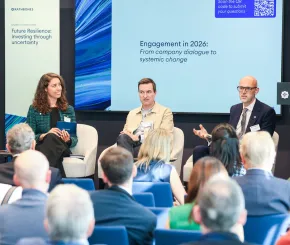
Olivia: Brilliant. Thank you very much, Will. hi, everyone. My name's Olivia Marlow. I'm one of the senior investment directors on the charity team here at Rathbones. and I'm delighted to be joined by some of my esteemed colleagues. so this is Kate Elliot, who is head of our Responsible Investment Centre for Excellence at Rathbones, and John Wyn-Evans, who is head of market analysis. and we'd like to take a bit of time to discuss what we've just heard from Will and hopefully sort of distill that really into the implications of, of what we've heard specifically for charity portfolios, as well.
so before we move on to that discussion, I think we'd like to do another, another little poll, to get a quick sense of the mood in the room. so if you could get, get your, your phones up again and give us your views on, on this question: Where do you see global equity markets going over the next twelve months? So we've got a range, up nought to ten, up more than ten percent, down nought to ten, down more than ten, and then the sort of ultra-averse scenario of, a crash that we all very much hope is not the ultimate scenario.
so we'll let some of those come through. Where are we looking? Oh, good. I thought we might have a little bit more gloominess. No doomers. No doomers. no doomers. Phew. Up nought to 10%. I think that's very, very good to see. we very much hope, that is the case. Okay, thank you so much. That gives us a nice flavor of, of the mood in the room. So, John, maybe if I could start with you. Will's presentation obviously identifies these sort of three key factors- Yeah ... thinking about, you know, what are the most seismic things to think about in the next five to ten years. That's AI buildout and adoption, strategic fragmentation, and also fiscal strain.
and he also talks about these as, as very interconnected forces. Which of those three would you say is kind of the most important for markets, over the next five years?
Investors, traders and market volatility
John: Okay, I'm gonna cop out slightly here and say that over a ten-year period, you'll find that all of them dominate at some time or other. It's like a giant financial game of Whac-A-Mole. and you know, if you think of it from our perspective, I think earlier on in the preamble, we used the word investors, us as investors, and I would always like to characterize our-ourselves as investors, not traders.
However, the marginal dollar that moves around in markets, or pound, is traded rather than invested, it's fair to say, and it's always chasing the next big idea or the next thing to be frightened about. and I think from that point of view is what you'll find, is that there will be a sort of dominant theme at any one time. and these are th- probably the three biggest themes. There'll be lots of sort of subthemes, underneath the surface as well. the good news about that, and again, Will sort of referred to this, is when you get volatility in markets, it gives you opportunity.
So if you have bad news about a geopolitical event, or about some concerns about a fiscal crisis or whatever it might be, and you get a sell-off in the bond market, and you get a big sell-off in equities, and particularly th- the growth equities, which tend to be the ones that have been doing well, and they get sold off quite ha-harshly, - That gives you the opportunity to buy the dip, as everyone has been doing quite a lot successfully over the last few years. But often, the market will indiscriminately sell things because it's forced to. There's a lot of leverage in the system.
A lot of people have borrowed money to invest, and when the volatility goes up, the margin is called, and they have to sell those things off. And that's when you can get these opportunities. So I'd say from that point of view, all three are going to be dominant at various periods. However, I feel that the super dominant one, if you might say, is going to be artificial intelligence in whatever shape or form, or should I now call it special intelligence, according to Mr. Trump. And there's no doubt about the fact we've alluded to this huge amount of capital expenditure that is going into the industry.
It is an existential fight between these big companies to be the one who's going to win the game, as it were. The adoption is just extraordinary, the speed with which it is picking up, the use of tokens and stuff like that, for example, and the cost of it is coming down at an extraordinary rate as well for users. So we get this fantastic thing called Jevons paradox, whereby the cheaper something becomes, the more you use of that particular resource. So this is real. But it's moving so fast, it's discombobulating everybody at the moment, I think.
How AI may create new industries
And we look back, and Will, again, gave these examples of things that we didn't even think about where we could be at the turn of the century. And there is also the fact that new technologies enable other new technologies, and people always say, without the iPhone, you could never have had Uber, for example. So you need those new things to push us on, and we can't even imagine what they are. So Henry Ford famously said about his car, he said, "If I'd asked the people what they wanted, they'd have said a faster horse." So you don't know what you want until you get it. And I think we're going to find there's all sorts of new things.
And even in the last couple of days, you've had this new Meta Muse agentic AI app, which is now the fastest selling thing on the Apple Store, for example, which allows you to do all sorts of things on your own device, which has not really been possible in that way before. And if you look at how things have evolved on the AI side, a year and a half ago, everyone was saying, "Well, Google's toast because its advertising model is going to be destroyed." And then suddenly it came out with its Gemini large language model that was embedded into the search that you use on Google, and it became very successful again. So that's had a big round trip.
Apple was seen as a massive loser because it wasn't spending money. It's got something like $300 billion sitting in the bank at the moment. And yet now, people are going to say, "Well, actually, it's the sensible one because it's not been spending money." And actually, it is the gateway for lots of people, however many, two billion users or whatever, to access AI through their mobile phones. And suddenly, that perception has changed around, too. So this is not a linear process by any stretch of the imagination. There's going to be lots of back and forth and winners and losers.
And as I say, I think the next really exciting thing will be on the adoption side and which industries will learn to use it and faster. It takes a long time. Again, we've had all these scares along the way. Last summer, there was a report out by, this was a year ago now, just over a year, by MIT, which was saying only 5% of companies are adopting AI, and they basically said it's rubbish. And if you actually read the report, rather than most journalists did and just read the subject at the top, the headline, the reason was just they weren't ready to do it. And they've been trying to do one-size-fits-all approaches rather than tailoring it to their own businesses.
And now people are beginning to understand that you have to do more application-specific work, as it were. So it's really beginning to pick up, I think, quite strongly. As of the other two sides of it, the political and strategic side, I think that is just going to continue to be difficult. We're moving into a different regime of the world. Whether it'll change or not with a change of resident in the White House remains to be seen. But I think things are on a certain path right now, which will be difficult to change. But again, there'll be opportunity in that, and particularly things like supply chain resilience as being a really interesting area in which to invest. And then on the fiscal side, if you look at some of the projections from the Office of Budget Responsibility here, the Congressional Budget Office in the United States, it's just debts onwards and upwards as a percent of GDP. But we'll come back and talk a little bit later, I think, in one of the other sections about how we might address that.
But again, that's not going away, I'm afraid.
Protecting charities’ purchasing power
Olivia: Thank you. I think, yeah, just bringing it back to charity portfolios a little. I think for most of the investors in the room, and Will, perhaps if I could come to you on this. Charity investors are really looking to their portfolios to generate some form of inflation-related growth. And really it comes back down to what you talked about, Will, protecting our purchasing power, protecting the value of that over time. So with that in mind, how do you think these structural changes we've talked about will influence portfolio construction in the coming period?
Will: Yeah. Well, I think ultimately we are in a slightly different regime, and what you don't want to do is rip up the rule book. It's no change in investment philosophy, but it's more a change in implementation ultimately. And if you think about the world that we've come from in the last 15 years or so since the global financial crisis, in an environment where largely interest rates were pretty low, bond yields were pretty low, inflation was pretty low, interference from governments was pretty low, and I think all of those things are changing. I don't genuinely think we have a structural inflation problem, actually.
I think if the oil price does calm down and get back into the $70s with some kind of deal with Iran or some kind of fudge, and who knows if that's going to happen or not. But I think that actually takes quite a lot of the pressure off. But nonetheless, I think what is being demonstrated is economies can survive with slightly higher rates. So I don't think we're going back to a zero interest rate environment. So that's not necessarily a bad thing, but I think it does change how you put a portfolio together. I think it certainly encourages you to probably stick with an overweight with equities for the longer term, and ultimately, owning high quality businesses that can protect that purchasing power because they have competitive moats, they have mission critical products and services, and then they can increase price over time consistently, growing their earnings ahead of inflation. I think ultimately that is the most key way in order how you protect your long-term purchasing power.
The role of real assets
And then I think it's what you put those equities together with, and I think, again, there's probably more of a place for real return assets than perhaps there has been historically. I think that can involve things like commodities, and with that, I don't necessarily just mean gold. It can be other areas like copper, which we have some exposure to through a structured product, actually. So commodities can be a useful player in that infrastructure. I mean, we just talked about the demand for infrastructure. So whether it's companies playing in the infrastructure space with towers or in that energy infrastructure as well, we think that can be a very interesting place to be. And also I'd add property into that as well.
And when I'm talking property, I'm not necessarily talking about your traditional office assets thing. You want to be more in specialised property. So whether that is mobile towers or whether that's REITs that are investing in data centres, so much more growthier areas. I'm going to say that energy infrastructure I think can be a really interesting place to be as well.
Olivia: Great. Thank you. And I guess your point about inflation not being structurally higher comes full circle to the idea that AI down the line is potentially going to be disinflationary, but we're clearly not there yet.
Will: Yeah, I think 100%. That is the thing. We're in the build-out stage, and AI in itself is causing pockets of inflation. And if you saw that your Apple iPhone price has just gone up 20%, and that is ultimately because of shortage of parts driven by this AI build-out. So arguably right now, AI is actually a bit more of an inflationary force. But as we've seen with just about every technology in history, they will tend to be deflationary. And certainly everything we see about how companies are likely to embed artificial intelligence suggests it's likely to be a more deflationary force, so I completely agree.
Responsible-investment risks associated with AI
Olivia: Kate, we've come to you. Will's presentation suggests that AI investment will ultimately move from infrastructure towards wider adoption, and also that compute, data, and power are all going to be quite critical strategic resources. What responsible investment risks should charities, should investors be aware of against that backdrop?
Kate: I think that the key takeaway is that AI, like any other innovation or technology, is not inherently good or bad. It's about how we as investors, as charities, as citizens, help to shape the way in which that technology is deployed, is utilized, is governed. And that will be absolutely critical to the lasting impact that it has as a technology on our societies, on the environment, and on the economy.
I would say there are three kind of interconnecting issues that we need to be kind of particularly aware of as we're considering these risks and opportunities. I was going to say, is my mic working? Yep. Perfect. So firstly, we've got the physical footprint. You've heard from Will the very visual perspective of the scale of some of these data centres that are being built out. And that brings particular impacts on energy security and on water security. Water is used within these data centres for cooling the infrastructure, increasingly within closed loop systems, which are more efficient, but still have localized impacts on water demand.
And if you look at data from the International Energy Agency, so they reported last year that energy demand from data centres had risen by 17%, and they were forecasting it to double as we move out to 2030. And at a kind of national level, you might consider actually our systems are robust enough to be able to absorb that increased demand, particularly as you build in the kind of energy efficiency that we're seeing per AI request or kind of automation undertaken. But that can sometimes lose sight of the particular local impacts of these site-specific factors.
And that's particularly true, I suppose you can think of it almost as a double-edged sword, because on the one hand, you've got the hyperscalers who have demonstrated that they are incredibly willing to invest in securing that supply. So in some ways that can unlock some of the capital that is much needed into grid upgrades and infrastructure upgrades. But on the other hand, and particularly in the short term, we're seeing growing demand and growing pressure for fossil fuel-based energy, because as much as we see the headlines around kind of renewable power purchase agreements being signed by many of these organizations, that is not sufficient to keep pace with the growing scale of demand.
AI adoption, bias and accountability
I'd also pick up on what's been spoken about already, but the potential implications and adoption of AI into different sectors. And that again, can be a double-edged sword because we can see the huge potential for benefit. If we think about AI applications within healthcare and some of the speed of delivery and innovation that we are seeing in that space, I think we could find stories of that ilk that are relevant to all of you and the missions of all your organizations. But at the same time, we need to ensure that there is proper oversight and governance of that AI build-out in those different contexts.
That importantly, we understand the way in which there may be biases that are inherent in the models being used and the decision-making as a result. That we have proper human accountability for key decision-making, even if it is guided by AI. And then that kind of brings me on to the third issue, is around the governance and accountability gap. So it's been hugely prominent in the news recently about questions of whilst we are seeing governments react to AI and the more existential threats it may pose to us as a society, but the degree to which regulation, which is famously slow-paced, can keep up with the pace of change and the potential use cases of AI. And if we think about that just at a very kind of minor scale, the kind of agentic economy, and as that builds out, in a scenario where you have agents that are enabled and empowered to contract with each other, so you allocate capital independently of a human decision-maker, when that inevitably goes wrong, as it will in some instances somewhere down the line, where does the buck stop from a kind of regulatory oversight perspective, from a legal enforceability perspective?
These are all key questions that kind of we as investors, that yourselves as charity representatives, need to be able to grapple with. And I think one of the key levers that we see in our ability as investors to promote guardrails around the build-out and adoption of these technologies is through engagement. So engagement with the companies that are building these AI models, that are building the data centres, and engagement at a policy level to encourage appropriate safeguards and guardrails around that.
Rethinking diversification
Olivia: Thank you. Very interesting. Will, coming back to sort of portfolio management, if these areas you talked about, security, resilience, and sovereignty, are increasingly driving where capital is allocated, what does effective diversification look like now in a charity portfolio, be that across regions or asset classes or whatnot?
Will: Yeah, I think region's a really interesting point actually, because there's often been this sort of view that you get good diversification by having a bit of US equities, some European equities, some Asian equities. But actually, if you look at what has happened this year, actually the strongest markets have been Korea, Taiwan, and the US. And the reason they've all gone up together is because they all have a significant amount of exposure within those markets to artificial intelligence. So if you just own those three, you'll be feeling pretty good about the world right now. However, mid-June, you'd be feeling a little bit sore because they all kind of sold off at the same time. So when you're building those portfolios, I'm not sure geographic works quite as well as sector diversification.
I think that's probably a much better approach. When you're just thinking within the equity part of your book, that's much more how I'd look to diversify a portfolio. Having said that, as I pointed out in the presentation, there are so many parts of the economy and so many different sectors now which touch artificial intelligence. Again, you have to be a little bit careful that you're not overly exposed to one factor, to one theme, because there are risks around all of what I talked about today. As much as we do like AI, many of the investments around that for the longer term, there are going to be periods when it can unwind.
There are risks to it, whether that is regulation or something else. Some of the pushback against data centres in the US, for example, and then you suddenly find that you thought you had technology, and you thought you had some industrials, and you thought you had some utilities, but actually, all of those are feeding into artificial intelligence, so they're all selling off at the same time. So at that point, whilst you can diversify by sector, you have to very closely watch what you own within that and really understand what the sort of revenue drivers are and how those different stocks are behaving and how they're correlating to each other.
Protecting portfolios against different risks
And then from an asset class perspective, I think you need to make sure you diversify by economic outcome. Again, when I talk about you want to be skewed towards equities, equities typically are a risk-on asset class. I think that's the right place to be for the longer term. But again, building that resilience into portfolios, if you get a broader sell-off, those equities are going to not be your friend. And therefore, you're going to have to look to other asset classes to pick up the baton to provide you with some protection.
And I think certainly in the world we're in at the moment, what you do not have is a sort of risk-free asset that will protect you in any market environment. I think those days are gone. Once upon a time, it kind of was government bonds. But actually, with these sort of periodic inflation spikes that we're seeing right now, yes, they can be a useful tool if we go into a growth scare, if there's some form of financial crisis, whatever it might be, government bonds will perform well in that environment. But if it's a scenario where the oil price is going through the roof, then government bonds are not going to help you.
And we're kind of seeing a little bit of that at the moment. For the minute, equities are holding their own, so that's fine. But if you see that sort of caused by inflation, government bonds aren't necessarily going to be the best place to be. So you have to think about the risks that you want to protect your portfolio against and make sure in each of those scenarios, you have some risk-off assets in a portfolio that can help protect you. And they might be things you don't expect.
I know some of you can't invest in oil, but oil and oil majors can be a really interesting way of protecting against that kind of scenario. So it's often not even just even within equities, you can find parts of the equity spectrum that can protect you nicely in certain risk-off scenarios.
Fiscal strain and fixed income
Olivia: Thank you. We've got a couple of questions and please do keep your questions coming through. If we don't get to them, which I'm very sure we won't, we will be circulating some answers after in the post-conference communications.
But there are a couple on fixed income, and this concept of fiscal strain being such a key strategic force. I guess, John, maybe I'll come to you on this. The presentation talked about higher government debt. Clearly interest costs have moved significantly upwards. How does that sort of backdrop affect inflation and of course, with the operating environment for charities in mind there?
John: Yeah, I think what's going on with bonds at the moment, and I would urge you to go to our website, read this week's and last week's weekly digest, because I've actually been writing about this quite specifically, over that period and also what it means for portfolio construction.
Per se, the bond yields are not necessarily that scary. They seem scary because they've come from close to zero to around about 5%, and yet, they are actually around about nominal growth, which is where they should be. And actually, the anomaly was how low they were for such a long period, as quantitative easing was taking place and central banks were buying bonds. So, the positive thing now you can say at least there is some income in the bond market at last. The question is, are you ever going to be paid that income in the future?
Are you going to get paid your bond back in the form that you expected to when you bought it? Is that going to be inflated away, in some cases through financial repression? I think these are all the questions that we're asking. So from your perspective, I think the key thing to look at is how you kind of defend the real value of the assets within the portfolio. And Will has referred to that, I think, through having real assets, as it were, in that, and that you can spread that out over a number of things.
And then obviously from the income point of view as well, being able to continue growing that income. But if you look at the point, not there were four or five years ago, four years ago, index-linked gilts had a negative real yield. So basically, you were guaranteeing that you were going to get less than the real value of your money back over the lifetime of owning that particular gilt. Now they have a positive real yield, somewhere between 1 and 2%, depending on your maturity you look at. In the United States, tips yield 2.6 real, which I think is actually pretty attractive. It's over three at the 30-year level.
So there are some positive things around about this, but obviously having to balance that within the portfolio setting is key. And then, as I say, whether or not the governments will ever bite the bullet in terms of spending and being able to sort of pull that back within the political situation we're in remains to be seen. It usually takes a crisis to force it upon somebody, unfortunately.
Reviewing responsible-investment policies
Olivia: Yeah. Brilliant. Thank you. I think we've covered quite a lot of, actually, the questions in our sort of discussion anyway.
So I guess in light of time, could I ask maybe you to give a sort of quick takeaway or main takeaway from the session and what we've discussed, as a sort of closing remark? Kate, perhaps I'll start with you.
Kate: Yeah. Fine. I think the key thing for me, reflecting your responsibilities as trustees, obviously ongoing review and update of your responsible investment policies. Now, that's not about kind of whipsawing to whatever the hot topic in the news is, but it is about making sure that you have set aside the time on a periodic basis to consider how the world around us is changing, and if and how any of those elements might need to be reflected back into the way in which you want your investments to reflect your objectives and mission of your organizations.
Olivia: Will, to you.
Staying invested for the long term
Will: I think it's just to stay invested and remember how long your time horizons are. They are very long. Economies bounce back, companies innovate, and over long term, equities compound very nicely and they will help you meet your longer-term objectives. Don't get panicked out by any short-term volatility that's going to come. It will provide some opportunities. But stick with it long term.
John: Yeah, I mean, I reflect sort of the stuff that Will was saying, really. I spend about 80% of my time engaging with clients and trying to talk them off a ledge, it seems. The two biggest questions I always get is, when's the next crash coming and when's the next financial crisis coming?
And for years now, I'm saying, "Not yet. I don't know when." And I think it's funny because we've got the word uncertainty there. So there's a thing called the Bloom Baker Uncertainty Index. So it's two US academics, well, it's actually a British and US academic, who've created this index of uncertainty, which goes back to the 1990s. And it's basically done from kind of scraping newspapers and more lately websites and social media and that sort of stuff, references to uncertainty. You could see big spikes along the way.
First big one was 9/11, then the financial crisis and the eurozone crisis, then COVID was the biggest of all because we all thought we might die. Russia's invasion of Ukraine, and the last big one was Liberation Day and the tariffs. But interestingly, it's actually come down quite a bit recently, and it's almost like we've got used to this sort of stuff. We've taken so many punches that we're actually quite strong to them now. Hopefully, it's not complacency. But I think all this resilience and again, the chart that Will showed of all the things that have gone wrong along the way, and yet returns have continued to head into that top right-hand corner of the chart.
Closing remarks
And then the final thing I would say, again from a psychological point of view, many years ago, it seems now it is, I studied German at university. And I didn't really like studying Goethe, to be honest with you. It was a bit sort of dense for me. But maybe I was too dense for him. I don't know which one it was. But anyway, when he was 82 years old and nearing his last moments, as it were, he looked back on his life and he said, "I've had a long and happy life, but I can't remember a single happy week." And I think that sort of sums it up. We're so in the news and the noise and everything, and there's so much to complain about, but actually when you look back on it, it was all pretty good.
So let's try and project ourselves a few years forward and think of the good things that might have happened along the way.
Olivia: I think that's an excellent parting thought. Thank you very much. Thank you.








.jpg?changed=1790581581)
_0.jpg?changed=1790591353)