









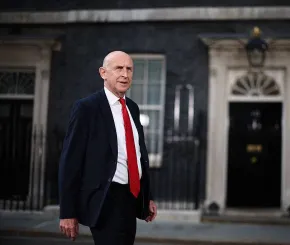
We look into the impact of John Healey's inaugural Budget.
Article last updated 3 November 2026.
Quick take
|
Investors are focused on three key global themes: AI, the Iran War, and monetary policy.
All are interconnected. Many market commentators and strategists attempt to isolate a single factor when attributing market moves but, in reality, the right box to tick is often the one saying “all of the above”.
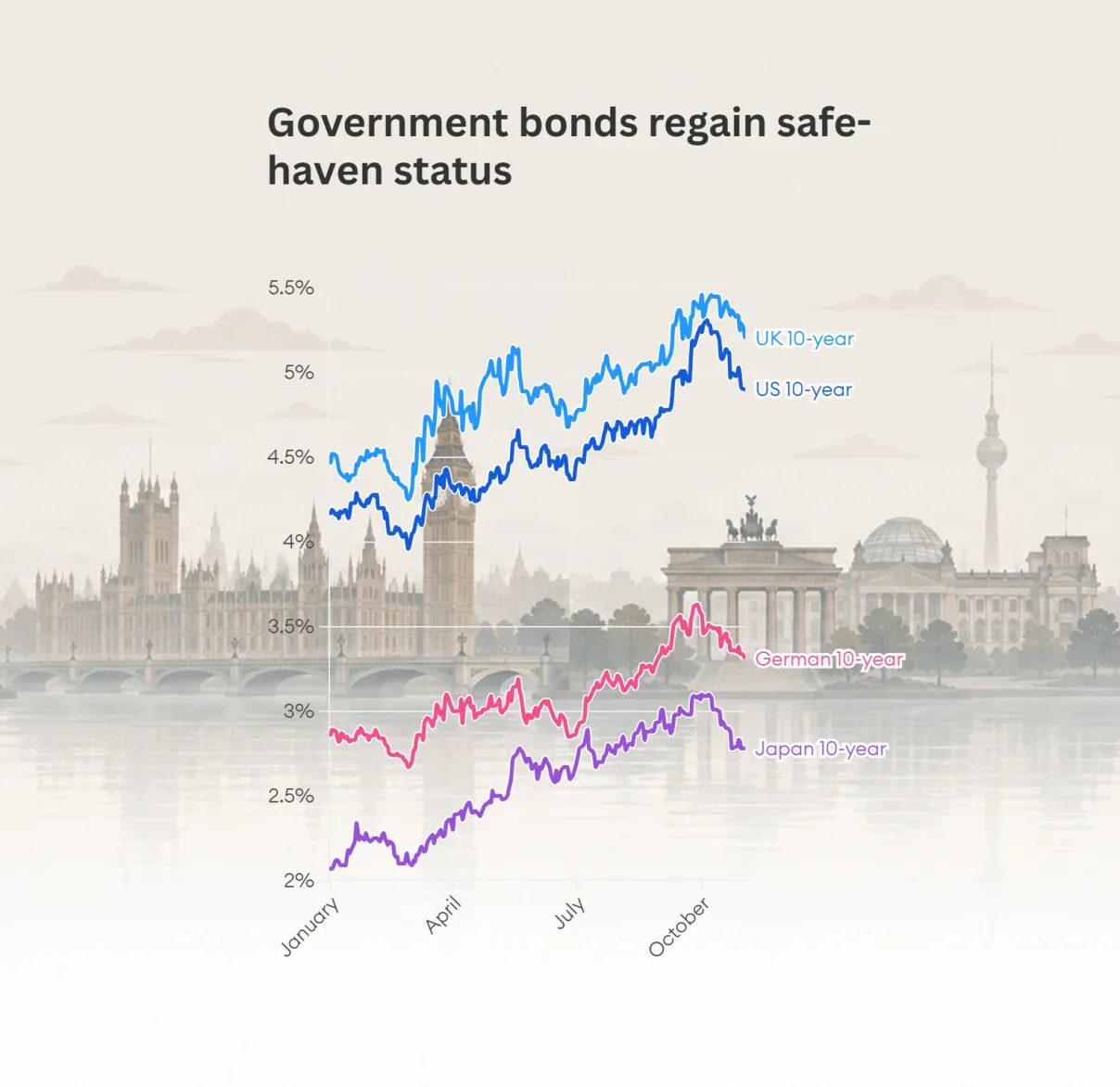
One key shift during October was the rehabilitation of government bond markets. Yields fell back (meaning that prices rose) as investors re-evaluated their ‘safe haven’ properties amidst rising concerns about the sustainability of the AI capital spending (capex) trade. There was also evidence that forced selling of bonds had pushed yields too high, at least for the current environment. Even so, with inflation remaining sticky at elevated levels and with fiscal deficits still an issue, it feels premature to signal an ‘all clear’ for bonds.
One issue that was resolved was the UK Budget. Chancellor John Healey displayed the hoped-for safe pair of hands and market impact was limited. But difficult, and potentially highly unpopular, decisions about spending cuts lie ahead.
Overall, balanced portfolios were little changed over the month as investors rotated within markets rather than making a wholesale exit. This was supported by a strong start to the third-quarter corporate reporting season.
Government bond yields have fallen back as investors re-evaluate their safe-haven properties.
Iran – no resolution
With the Iran War in its ninth month, there’s a diplomatic impasse. Our game theory approach to the situation maintained that both sides would ultimately discover their pain thresholds and reach an agreement. The fact that this has not materialised before the US mid-terms is a worry. Speculation abounds that military re-escalation will occur after the election, especially if the Democrats make substantial gains.
Meanwhile, the global economy has held up far better than expected, given the rising cost of energy and related commodities.
Much of this has to do with AI-related spending in the private sector and fiscal support in the public sector.
Suppliers and consumers have played their part, too. New routes have been found to export oil from the Middle East and strategic reserves have been tapped.
Even so, there is only so much capacity in these reserves – and the US’ are falling towards the level where further releases would compromise the structural integrity of the vast caverns in which oil is stored.
A resolution to the Iran War could be the single most positive driver of equities at this stage, especially if accompanied by a ceasefire in Ukraine. Unfortunately, neither can be relied upon so we need to invest accordingly.
This includes maintaining allocations to inflation-linked government bonds, as we help you invest well to live well.
Inflation and interest rates
The global economy is much less energy-intensive than fifty years ago: it uses about a third as much per unit of output.
But fuel costs still play a strong role in driving inflation. The headline rate of UK consumer price inflation has risen to 3.5%.
Central banks find themselves in a difficult position. They want to head off the risk of higher inflation setting off a vicious circle of higher wage demands and even higher prices to accommodate them. But they’re aware of the depressing effect that elevated energy prices have on consumption in the rest of the economy. There is evidence that across the world, consumers are putting off consumption of durable goods as consumer prices rise – a possible drag on growth. This calls for a more measured approach.
The US Federal Reserve has so far increased the Fed Funds rate by 0.25 percentage points, taking the upper bound from 3.75% to 4%. Market expectations are for more increases, although it’s hard to be sure of the intentions of the new Chairman, Kevin Warsh.
The Bank of England is expected to raise the base rate by 0.25 percentage points to 4% this week. The market is pricing in as many as four quarter-point increases by September 2027, taking the base rate to 4.75%. A lot will depend on energy prices over that period, but, in our opinion, that looks too high.
Still, we acknowledge that more central banks around the world are currently raising interest rates than since 2022. So there is a risk that the higher cost of capital will begin to weigh on economic activity.
AI – more questions than answers
A lot of questions are being asked about the future of AI. More immediately, there are at least three major concerns for investors.
First, will capital be available to sustain the investment boom? The US hyperscalers, the companies building data centres, maintained their spending projections during the latest results season. These total more than $1tn a year for the next three years. But with interest rates and bond yields rising, the costs are rising too. There’s also considerable competition for funds from governments, which continue to run fiscal deficits. Weaker players could be squeezed out.
Second, are there roadblocks ahead to development? These might include insufficient power or raw material supplies. We’re already seeing voter pushback influencing the mid-term elections as candidates are now vying to be the most opposed to further development in their states. And Democrat politicians may seek to apply the brakes to AI expansion should they gain control of Congress.
Third, there’s the question of returns. Will enough users spend enough money to justify the expense of both developing the frontier models and providing the computing power to use them?
A recent paper by Stijn van Nieuwerburgh, a Professor of Finance at Columbia Business School in New York, casts doubt on the outcome. By his calculations, this fledgling industry will have to be generating annual revenue of $3.5tn by 2032 to make a (still slightly underwhelming) 10% return on capital.
That’s equivalent to around 8.5% of US GDP. And that’s just for the US players.
We still see AI as a paradigm-shifting technology that will enhance productivity in ways that we cannot even currently imagine. Even so, we’re cognizant of the risks and are spreading our exposure broadly across hyperscalers, chip manufacturers, and ‘picks and shovels’ suppliers, as well as investing in companies that might benefit from the adoption. The healthcare industry, for example, is a potential winner – look out for the next edition of our Investment Insights magazine, which covers this. We also eschew the more highly leveraged companies that are almost solely reliant on increasing amounts of debt to fund their ambitions. In the AI space, these are the so-called ‘neoclouds’. And we maintain allocations to government bonds as a counterweight to the risk that AI-related growth disappoints.