The problem with financial complexity
As careers progress, financial arrangements build up. Pensions, deferred bonuses, equity schemes, investments, property and trusts all serve a purpose, but they're often established at different stages of life and reviewed in isolation rather than as part of a coherent whole.
That can leave gaps that deserve a closer look:
- Pensions not reviewed since legislation changed
- Wealth spread across multiple structures with different objectives
- Family commitments built into day-to-day spending but not reflected in long-term planning
- Estate planning arrangements that may no longer match current intentions
A cash flow model brings everything together in one place and shows how it may evolve over time.
What cash flow modelling does
A cash flow model uses your income, pensions, investments, property, business interests and planned expenditure to build a long-term picture of your finances. It helps you understand:
- Whether you're on track to achieve your goals
- How much financial flexibility you may have
- The likely impact of major decisions before you make them
- Areas where acting now could strengthen future outcomes
It doesn't predict the future. Investment returns, inflation, tax rules and life events will all change. Its value lies in helping you explore different possibilities using realistic assumptions and your own numbers.
Seeing it in practice
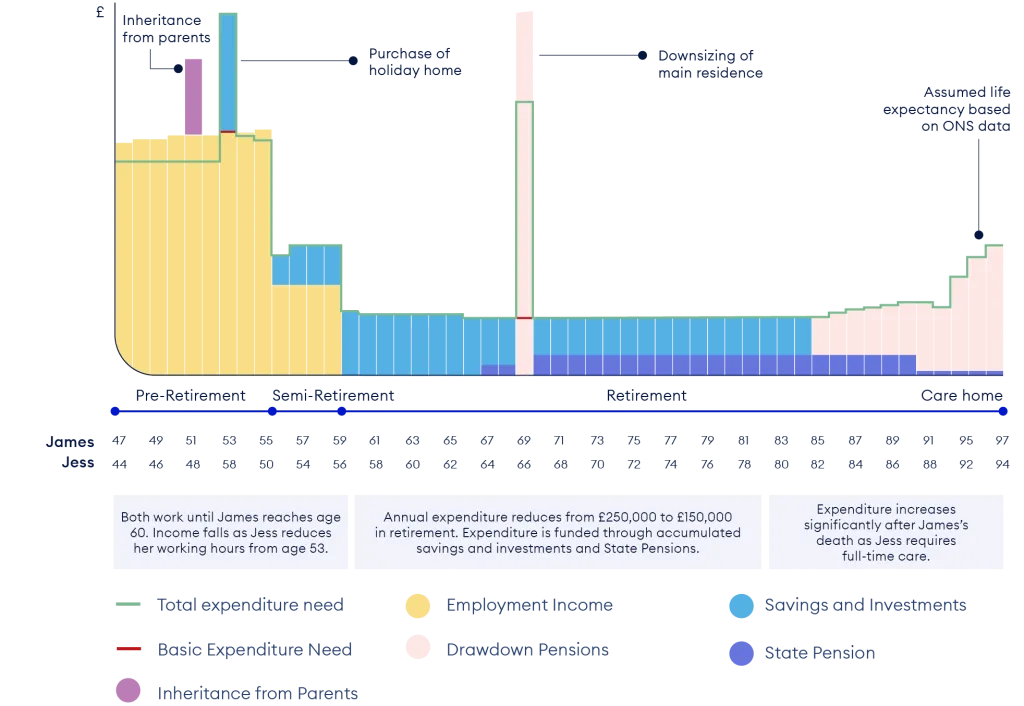
James (47) and Jess (44) are married with combined earnings of £880,000 per annum, the majority from Jess who is a partner at a Magic Circle law firm.
Their current needs are covered. Now they're planning ahead. With two teenage children and retirement approaching, they want to:
- Fully retire by the time Jess turns 57
- Reduce Jess's working hours from age 53
- Buy a holiday home at age 50
- Pay off their mortgage and downsize before retirement
Their cash flow model maps these goals against income and spending across their lifetimes, giving them a clear view of how to fund the retirement they've worked hard for.
Key findings from their model:
- Both work until James reaches 60. Income falls as Jess reduces hours from 53
- Annual expenditure reduces from £250,000 to £150,000 in retirement, funded through accumulated savings, investments and State Pensions
- Expenditure rises significantly later as Jess requires full-time care
The model can also be updated to explore helping children onto the property ladder, the impact of a market downturn and more tax-efficient ways of drawing on different savings in retirement.
This projection uses assumptions including inflation, salary increases, investment returns and tax rates which may affect the outcome. It is based on current legislation, which is subject to change. Actual results could vary significantly.
The scenarios most professionals want to explore
A cash flow review opens up conversations that are hard to have without the numbers in front of you. For most professionals, three areas come up most often:
Career transitions and retirement
Whether you're leaving a partnership, winding down or moving into a new phase of life, understanding the financial implications helps you make decisions with confidence rather than assumption.
Family and passing on wealth
Many professionals are supporting children, parents or wider family members. Whether that's helping children onto the property ladder or thinking about what you'd like to leave behind, a cash flow model helps you understand what's possible while keeping your own long-term security in view.
Protection and resilience
A review often highlights where financial protections need updating: income protection, life cover, business protection and legal planning. A strong financial plan isn't only about building wealth. It's also about protecting what matters most.
Why the timing matters now
From 6 April 2027, most unused pension funds and pension death benefits will form part of an individual's estate for inheritance tax purposes, with further HMRC guidance and implementation details expected.
For many people, this changes how pensions should be used within wider estate planning. Considerations include:
- Whether drawing pension benefits earlier makes sense in your circumstances
- How pension withdrawals compare with potential inheritance tax liabilities
- Whether existing gifting or trust arrangements remain appropriate
- Whether wills and other estate planning documents still reflect your intentions
A cash flow review helps you work through these questions in the context of your full financial picture, not in isolation.
A plan that evolves with you
Life changes. Markets change. Tax rules change.
A cash flow model should change too.
After a partnership exit, business sale, retirement planning decision or shift in family circumstances, reviewing the model keeps it aligned with your goals. Over time it becomes a valuable decision-making tool, not something you build from scratch each time, but a living view of your finances you can update as things develop.
The next step
Reviewing your finances doesn't mean something is wrong. In many cases it confirms plans are on track and provides genuine reassurance.
Sometimes it identifies opportunities or highlights areas worth attention.
Either way, you gain a clearer view of the choices available to you.
To discuss cash flow modelling and review your financial position, speak to your Rathbones financial planner about arranging a no-obligation conversation.