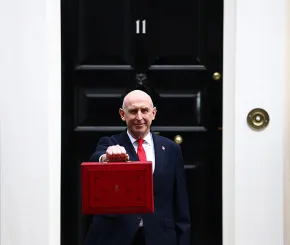
What did the 2026 Autumn Budget announce?
After a relatively subdued period of pre-Budget speculation, Chancellor John Healey’s first Budget provided the first real opportunity to see how Andy Burnham’s government intends to approach the difficult balance between raising revenue, supporting growth and maintaining confidence. Here, we take you through the key announcements and what they could mean for your finances, both now and over the longer term.
This article reflects the announcements made in the Autumn Budget on 28 October 2026. Some measures may be subject to consultation, and all are subject to legislation.
The details may change before they become law. This article is for information purposes only and doesn't constitute financial advice. Tax rules depend on individual circumstances. Please speak to a qualified financial planner before taking action.
A Budget of breathing space, but who pays the bill?
Billed as a Budget for working people, the government says its measures will give families and businesses some much-needed breathing space by bringing down the cost of living and the cost of doing business. But with the public finances still under considerable pressure, that support has to be paid for. So who is picking up the bill?
As expected, the headline rates of income tax, VAT, and National Insurance remained unchanged. The Chancellor instead focused on more targeted measures affecting wealth, investments and other assets. For many people, it’s the less headline-grabbing changes that could have the greatest bearing on their financial plans; those that have built businesses, accumulated savings and investments, or are planning for retirement and the next generation.
Increase in savings and property tax rates
Tax on savings income and property income will increase by a further 2% at the basic, higher, and additional rates from 6 April 2027.
This makes the location of cash and interest-bearing investments more relevant to clients with substantial taxable portfolios. This reinforces the case for making larger emergency funds and specific cash holdings as tax-efficient as possible, particularly where significant cash or fixed-interest assets are held outside tax wrappers.
People with personally held investment property potentially face a higher tax charge on rental income. Combined with the savings income increase, there is a fairly clear theme: the government hasn't increased the headline rates of ordinary income tax, NIC or VAT, but some forms of unearned income are being asked to contribute more.
What about ISAs?
Did Lifetime ISAs survive? Yes, but in a different form.
The government plans to replace the Lifetime ISA with a new First-Time Buyer ISA, designed solely to help people on to the property ladder. Existing Lifetime ISA holders will be able to retain their accounts and continue contributing, while the replacement is intended to offer greater flexibility and remove one of the biggest criticisms of the current scheme: the penalty for accessing savings for purposes other than buying a first home.
Was the cut to the cash ISA allowance reversed?
In last year's Autumn Budget, former Chancellor Rachel Reeves announced that the cash ISA limit would fall from £20,000 to £12,000 from April 2027. The aim was to encourage more people to invest in stocks and shares. The Chancellor confirmed that this planned cut to the cash ISA allowance won't go ahead.
Chancellor Healey has said a cut was the wrong way to do this. Instead, the government will focus on helping savers understand the potential benefits of investing.
What you can do: You can still put up to £20,000 a year into ISAs, and all of it can be in cash if you choose. Cash ISAs are useful for emergency savings and shorter-term goals. For money you won't need for at least five years, investing through a stocks and shares ISA may offer the potential for greater growth, although its value can go down as well as up and you may not get back what you invested. If you're married or in a civil partnership, remember that you each have your own £20,000 allowance.
Capital gains tax (CGT): did rates rise?
Despite CGT attracting considerable attention ahead of the Budget, and proving a bit of a worry for some of our clients, CGT rates are to remain at 18% and 24%, and the annual exempt amount stays at £3,000.
What announcements were made about pensions?
The rules around pension tax-free cash remain unchanged. Most people can still take 25% of their pension as a tax-free lump sum, up to the standard Lump Sum Allowance of £268,275.
This entitlement has been the subject of pre-Budget speculation for several years. Cutting it could have raised up to £2bn a year, but it would have been deeply unpopular. For those approaching retirement, the absence of a change provides some welcome certainty. But, as ever, tax shouldn’t drive your plans. Decisions about taking tax-free cash should be made in the context of your longer-term retirement strategy, rather than in response to speculation surrounding any one Budget.
A new Pension Tax Allowance will be introduced from April 2027, designed so that pensioners whose income is at or below the full new state pension aren't dragged into income tax merely because state pension increases take them over the personal allowance. The full new state pension will rise by 3.9% to £13,036.
The government is signalling how it intends to tackle one of its biggest long-term costs, by reforming the state pension triple lock in April 2030.
Inheritance tax (IHT): what changed?
There was no further tightening of Business or Agricultural Property Relief, despite speculation ahead of the Budget. This provides greater certainty for families planning the future ownership of businesses and agricultural assets, but succession plans should still be reviewed regularly as circumstances, valuations and tax rules evolve.
The nil-rate band is the amount you can leave free of IHT. It’s been frozen at £325,000 since 2009 and will now stay frozen until 2031. The residence nil-rate band adds a further £175,000 if you leave your family home to your direct descendants. However, for many families, these limits haven’t kept up with rising house prices, meaning more of their wealth can potentially fall within the IHT net.
The Finance Act 2026 already confirmed that most unused pension assets will come within IHT from 6 April 2027. For many families, pensions have long been one of the most tax-efficient ways to pass on wealth. If your estate plan relies heavily on pensions, business or agricultural reliefs, or existing IHT allowances, now is the time to check it still does what you want it to.
Fiscal drag: the squeeze continues
Income tax thresholds still remain frozen until 5 April 2031. This means as earnings and other income rises, more people can find themselves paying tax or moving into higher tax bands, even though the rates themselves stay the same. This is known as 'fiscal drag'.
Pay reviews, promotions, and inflation-linked rises can all pull people into a higher tax band. The effect can be gradual, but over several years it can make a meaningful difference to the amount of tax you pay.
Continue to take particular care if your income is close to £50,270, where the higher rate starts, or £100,000, where you start to lose your personal allowance. Tax thresholds shouldn’t dictate your wider financial plan, but understanding where your income sits can help you make more informed decisions. Salary sacrifice, pension contributions, and giving to charity can all reduce your taxable income.
What should you do now the Budget has been delivered?
The most important message is, stick to your plan but take advice if needed. Budgets inevitably focus attention on tax, but tax changes shouldn't be allowed to dictate long-term financial decisions. Some measures may take effect immediately, while others may be subject to consultation or require legislation. What the Budget does provide is greater clarity, making this a good time to review your plans and understand whether anything needs to change.
Five things to review with your financial planner in the weeks ahead:
Your savings and investments
Understand how the new rates affect the cash and investments you hold outside an ISA or pension. Continue to make full use of tax-efficient wrappers, allowances and planning between spouses.
Your pension
Review when and how you intend to take pension benefits, including tax-free cash. Separately, if pensions form an important part of your estate plan, consider the impact of most unused pension assets becoming subject to IHT from April 2027. Neither change should be considered in isolation from your wider retirement and estate-planning objectives.
If your retirement plan assumes the state pension will keep rising in line with earnings, see how it looks under the planned 'double lock’ from 2030.
Your estate plan
Not a huge amount of change, the starting point should always be who you want to benefit, when and how, rather than tax alone.
Your income
If your income is close to an important tax threshold, consider the effect of earnings, bonuses, pensions and investment income. Pension contributions and charitable giving could make you more tax-efficient.
Property
If you own an investment property, review the property's after tax return, make sure you're using the available allowances and deductions, and consider whether it still fits within your wider financial plan.
Final thoughts
A Budget can change the tax landscape, but it shouldn't change the principles of good financial planning. The right response is rarely to act simply because tax rules have changed. It is to understand what those changes mean for you, revisit your objectives and make considered decisions with the longer term in mind. Please note that Scottish limits can be higher or lower.
If you'd like to talk through any of these areas, please get in touch with our team. We're here to help you make sense of what's changed, calmly and clearly, with your long-term interests at the centre of everything we do.
Good financial planning is rarely about reacting to announcements. It's about making sure your plans hold up, whatever the Chancellor decides.
What should you do next?
The Autumn Budget brings significant changes that could impact your wealth strategy, including frozen tax bands, dividend tax increases and a clampdown on salary sacrifice. These measures may affect property owners, business directors, high earners, and families with complex financial arrangements.
If any of the points outlined above resonate with you, now is the time to talk. We’re here to help you navigate Budget-driven changes, protect your wealth, and identify opportunities.
Please get in touch with your Rathbones adviser today to review your plan and ensure it remains robust in this evolving landscape, or complete the form below if you'd like us to arrange a no-obligation conversation.
Take action
If you would like to talk to one of our team about the announcements in the Budget and how we could help you make a plan, please fill in the form below and we'll get in touch. Alternatively, please feel free to call us on 0330 390 9191 and we’d be happy to help.
Latest Autumn Budget analysis

Building prosperity: The growth test
Are tax and economic policies helping or hindering investment, entrepreneurship and long-term prosperity? We share five recommendations to help the UK save, invest, and live well
Building prosperity: The growth test
Visit our Autumn Budget hub






.jpg?changed=1793110259)